
Youthful over-confidence?
Back in my 20s I was an enthusiastic republican. I was impatient for change and thought I had some creative ideas. I had graduated from La Trobe University’s Behavioural Science department when tertiary education was still free, thanks to the Gough Whitlam Labor government. I saw myself as a brave progressive.
I visited my relatives in England and researched the 17th Century Civil War sites of the Parliamentarians and Oliver Cromwell. I was inspired by English Republicanism and the English Commonwealth. I told my relatives, “I think we should get rid of the monarchy before YOU do!” It wasn’t very gracious and I look back in gratitude at how well they humored me.
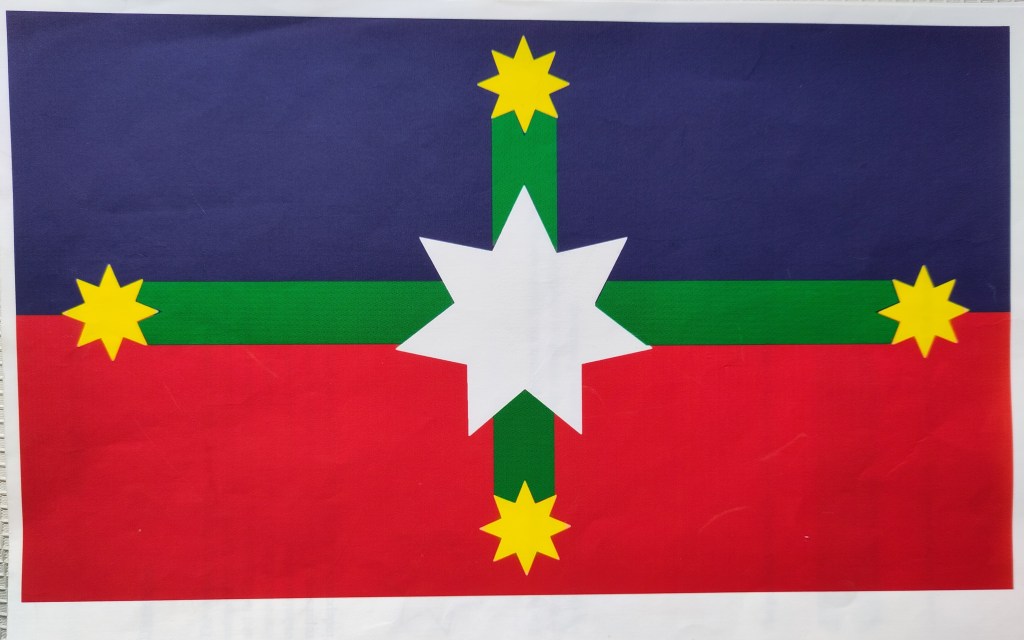
I designed the above flag with the following description:

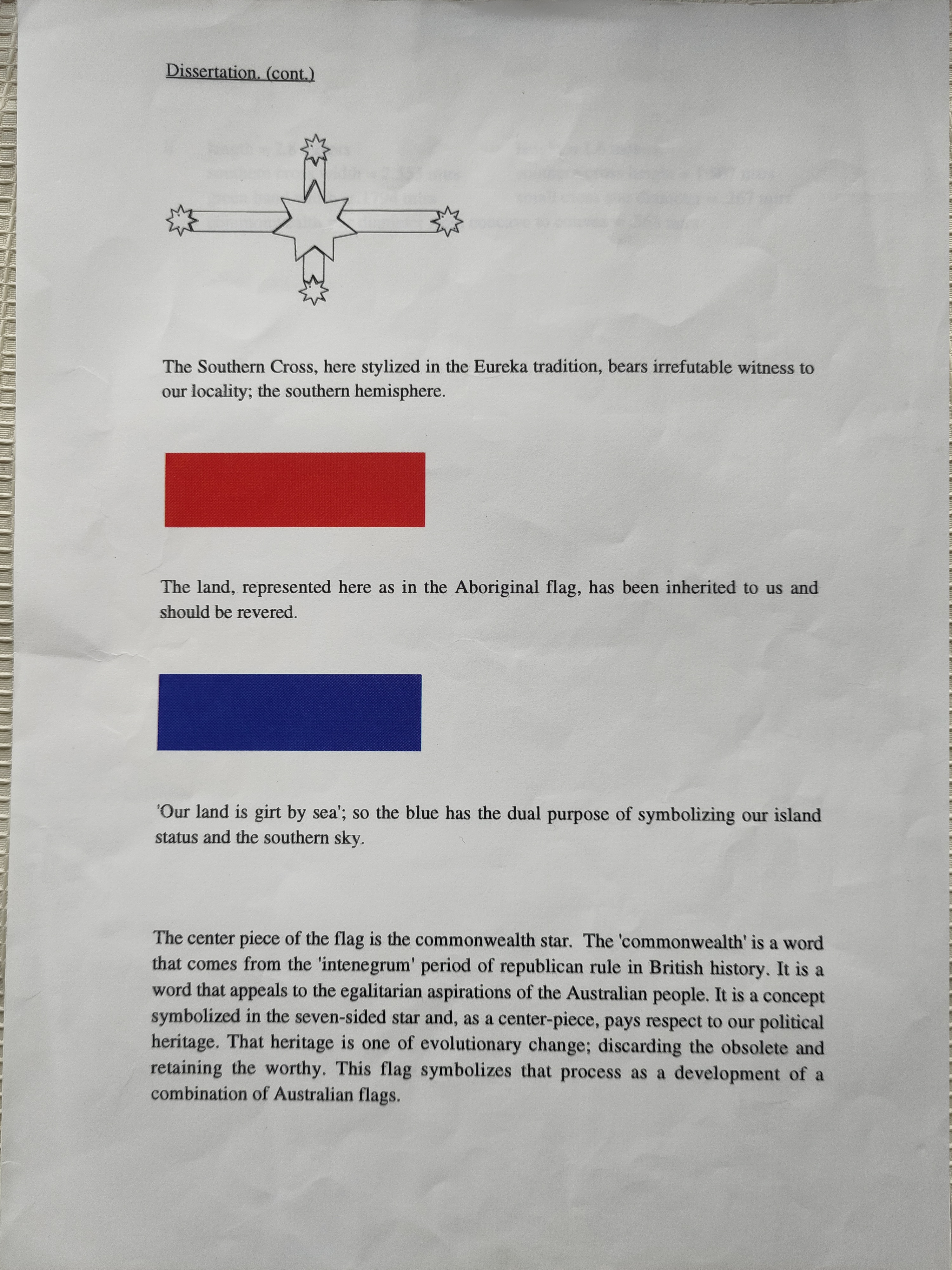

Exuberant discontent
It wasn’t until decades later that I learnt about heraldry – the rules for flag design. The best flags have no more than 3 colours, for example. There are many other rules and some national flags break them (which probably accounts for their obscurity). But what impressed me upon this discovery was that it hadn’t occurred to me that I was venturing into a field I knew next to nothing of and that experts were steeped in knowledge about. “Vexillology (/ˌvɛksɪˈlɒlədʒi/ VEK-sil-OL-ə-jee) is the study of the history, symbolism and usage of flags or, by extension, any interest in flags in general.” (Wikipedia)
It was humbling. To be fair, I didn’t have the Internet at my fingertips, but the information was out there if I’d taken the time to search. Today, I have fewer excuses. Those who embark on a great new idea without doing any background research on the Internet end up reinventing the wheel.
Learning and change
There’s nothing wrong with making mistakes; they’re opportunities to learn. I think of myself as a life-long-learner. Similarly, I like to think Australia is willing to improve. And it is – it’s in our blood. We inherited a political legacy from the British of evolutionary change through compromise, ever since the painful learnings of the British Interregnum. I believe that is reflected in the way we have entered so earnestly into a process of reconciliation with Aborigines.
In the decades since the 1980s, Australia has been transformed by multiculturalism, population growth (mainly from overseas) and the on-going process of reconciliation with Aborigines. Some of this has been good, such as greater social egalitarianism and awareness of the Frontier Wars. Some of it has been bad, such as the loss of social cohesion and the impoverishment of the middle classes.
I watched some of this from Japan where I lived and worked from 1993 to 2007. I recall once flying back into Brisbane from overcrowded Tokyo and as I looked down on our beautiful big, spacious, barren continent with its modest human presence, I felt a deep gratitude and love for it. “The quiet achiever” BP ad came to mind. Small is beautiful. I felt immensely proud of our humble environmental footprint.
It seems Australia was on a different page. It has pursued a path of growing the human enterprise aimed at greater global political and economic influence. Such vanity; neo-liberal social progressiveness on steroids designed to dupe the masses into believing they were becoming freer as wealth inequality exacerbated. And our beloved environment has paid a terrible price, not to mention future generations.
As the complaints about British heritage in Australia seemed to become a self-perpetuating feeding frenzy, I began to ask myself, “Hang on, why would I be in favour of that when it’s my ethnic heritage?” There are now fewer Anglo-Celtic Australians than ever. Given the global balance of cultures by population, diversification in Australia is actually the Asianization, Indianization, Arabization and now Africanization of the country. In our region of the world, European culture is a rarity.
But I am still open to change, albeit more restrained. Two and half years ago, I proposed the following design with a full explanation:

There were two main alterations to our existing flag: The Commonwealth Star is gold (or yellow) rather than white in honor of the Aboriginal flag’s sun. The Southern Cross is stylized as in the Eureka Stockade (often flown by republicans) to distinguish it from many other southern hemisphere countries’ flags, giving us a uniquely Australian symbol.
The Aboriginal flag succeeds because of its simplicity; it has only 3 colours.

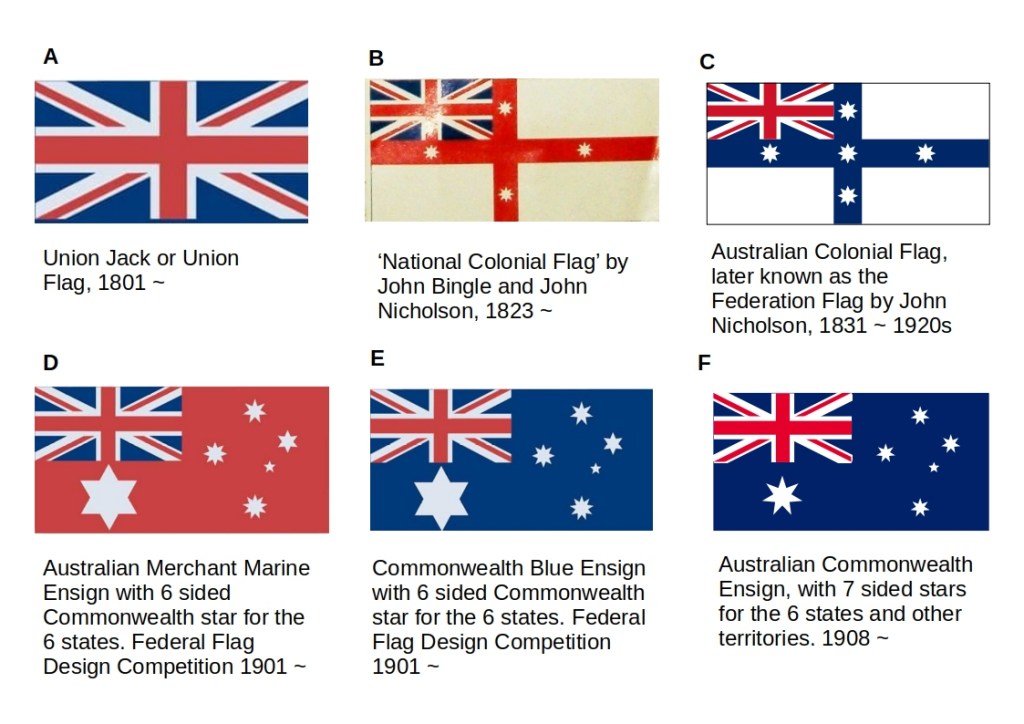
I subsequently learnt that Australians flew a Federation Flag (C, below) for nearly 100 years. It originates from an 1824 design by John Bingle and John Nicholson (B) with a stylized Southern Cross. The 1854 stylized Eureka Stockade cross bears a remarkable resemblance to it. Again, by delving into history, I was humbled to learn that the ‘republican’ flag had an earlier iteration. How many ardent republicans know this? How many know that in his diary, John Bingle, “claimed that this design … was accepted as the national colonial flag of Australia by the Government of Sir Thomas Brisbane.” (Department of PM and Cabinet)? Sir Thomas Brisbane was Governor of NSW at the time. Our first Prime Minister Edmund Barton submitted the blue version (C) to the British authorities in 1902 as an alternative to the design chosen for the Australian National Flag through the 1901 competition (E). See image C below:
My 2021 design compares poorly to our current Commonwealth Ensign (F) because of its forth color. Fix that and you get this:


I am still undecided that our Blue Commonwealth Ensign needs to change, but the stylized southern cross remains compelling. In this rendering, the stars have eight sides, it would be better if they were seven-sided as on the Blue Commonwealth Ensign’s Southern Cross. An alternative is to update the Federation Flag with Commonwealth Stars:

As Australians, we seem to live in a time defined by a quandary with our Aborigines. Last year’s Voice Referendum exemplified this. Do we integrate, or maintain separateness, as currently symbolized by the separate flags? Neither is an imperative, in my opinion. There is much to consider, but that is for another report. Time will tell how it unfolds.
What seems clear is that we are well past that wave of good will that came to a crest in 1967. The Referendum that year saw Australians vote overwhelmingly to amend the Constitution to allow the Commonwealth to make laws for Aboriginal people and include them in the Census of Population and Housing.
“The significance of the 1967 Referendum has been somewhat obscured by a number of myths. These include the misconceptions that the Referendum granted Aboriginal people citizenship, the right to vote, wage equality and access to social security, among other things.” (Parliament of Australia)
Without going into the details, there seems little doubt that we have descended into a state of acrimony despite decades of ‘paying the rent’. In my estimation, we have become stagnated in a dreaded drama triangle of ‘persecutor’, ‘victim’ and ‘rescuer’. We seem to be heading for a state in which victims rule; think of the tragic vicious cycle of child-bashers raising child-bashers. This is truly something to be wary of. I believe the way out of such toxicity is a period of calmness, distance, stability and acceptance. As David Emerald describes in The Empowerment Dynamic, the dreaded drama triangle can be reshaped into ‘challenger’, ‘creator’ and ‘coach’. But for the meantime, we need peace.


Leave a comment