
Do Humans Really Provide EcoServices?
IPAT is a mathematical formula put forward to describe the impact of human activity on the environment.
Impact = Population x Affluence x Technology
In this equation, the impact humans have on the environment is a result of how many there are of us, multiplied by how affluent we are, multiplied by how effective our technology is in delivering said affluence. The impact is generally to Nature’s detriment.

It has been suggested that human services that contribute to the natural environment’s well-being (as opposed to human activity that degrades it) should be factored into the equation. But can humans really make a significant, positive difference? Technology can be used to reduce our impact on the environment through efficiency gains and more sustainable practices, but these merely minimize negative impacts rather than produce a net positive gain to nature.
NEW ECONOMY SPAT
In October, 2019, Duncan Wallace, then Editor of the New Economy Network Australia Journal, authored some incendiary criticism of IPAT and its over-population ‘alarmist’ proponents in an article entitled, Overpopulation is Not the Problem: The Misanthropy behind I=PAT. He stated that,
a type of misanthropy is a central, unarticulated presumption behind their [over-populationist] thinking – or at least behind an equation central to their thinking: the identity I=PAT.
Duncan Wallace, October 7, 2019. Overpopulation is Not the Problem: The Misanthropy behind I=PAT. New Economy Journal. Volume 1, Issue 6

Wallace claimed that IPAT does not accommodate the positive impact humans can have on the environment – like regenerative agriculture and agroecology in higher yields of harvest.
He also claims the stewardship of ecosystems by indigenous people has resulted in not less diversity, but more. This is not easy to measure. Some sort of benchmark or starting point would need to be established to measure against. It would take a lot of work to gather the data and process it, but it would be well worth it. In Australia, it may well be that Aboriginal land managers maintain and in some cases revive local ecological environments. However, does it represent a net increase in diversity? Is the scale adequate? If the starting point is the arrival of humans on this continent and if they are responsible for the extinction of megafauna, has biodiversity increased since? It seems unlikely, given the track record of humans, but recently some of us are behaving differently.
Wallace’s attack on sustainable population advocates was unconvincing to me and receved very defensive reactions. It’s unfortunate that he took such a frontal assault and failed to provide adequate evidence, because he has a point. What he didn’t mention is the massive projects to reverse desertification across the world. Early last century, Franklin Delanor Roosevelt initiated the Great Plains Shelterbelt to restore the mid-west ‘dust bowl’ to arable farm land (see Why America Built A Forest From Canada To Texas Earth Curious. 2025). In China the Loess Plateau project is returning barren hilltops to vegetation (see TV Lessons of the Loess Plateau EcopointAsia, 2013.). In Africa the Great Green Wall is stalling the southward march of the Sahara and in Western Australia the Yarra Yarra Biodiversity Corridor Project is also reversing desertification.
Wallace proposed an addition to the I=PAT equation that takes into account the services humans can provide to enhance natural systems. The positive impact of these services should, he asserts, be deducted from the negative effects of Population, Affluence and Technology. He explains it thus:
| Population (P) | ≥ 0 |
| Services (S) (provision of ecosystem services) | > 0 |
| Technology (G) (how effective we are at performing services) | > 0 |
Here, we call technology G, to differentiate service technology from affluence technology, which is called T. So, our new equation for “Impact” is:
| Impact | = PAT – PSG |
| = P(AT – SG) |
This now allows Impact to be a negative value, if SG > AT (though, of course, it may very well be positive – it depends on how we behave!).
Duncan Wallace, June 9, 2020. An Empirical Objection to IPAT: A Reply to Mark Diesendorf. New Economy Journal. Volume 2, Issue 3
It is very difficult to conceive of human impact having a negative value, meaning the presence of humans results in a net increase in the natural environment and biodiversity, etc.. Currently, with more than 8 billion people consuming far more than they provide ecoservices, the net impact on the planet is having a devastating effect.
The Global Footprint Network measures this impact and can define, approximately, the day we start consuming more than the Earth can regenerate – Overshoot Day. Last year it fell on July 24th in 2025.
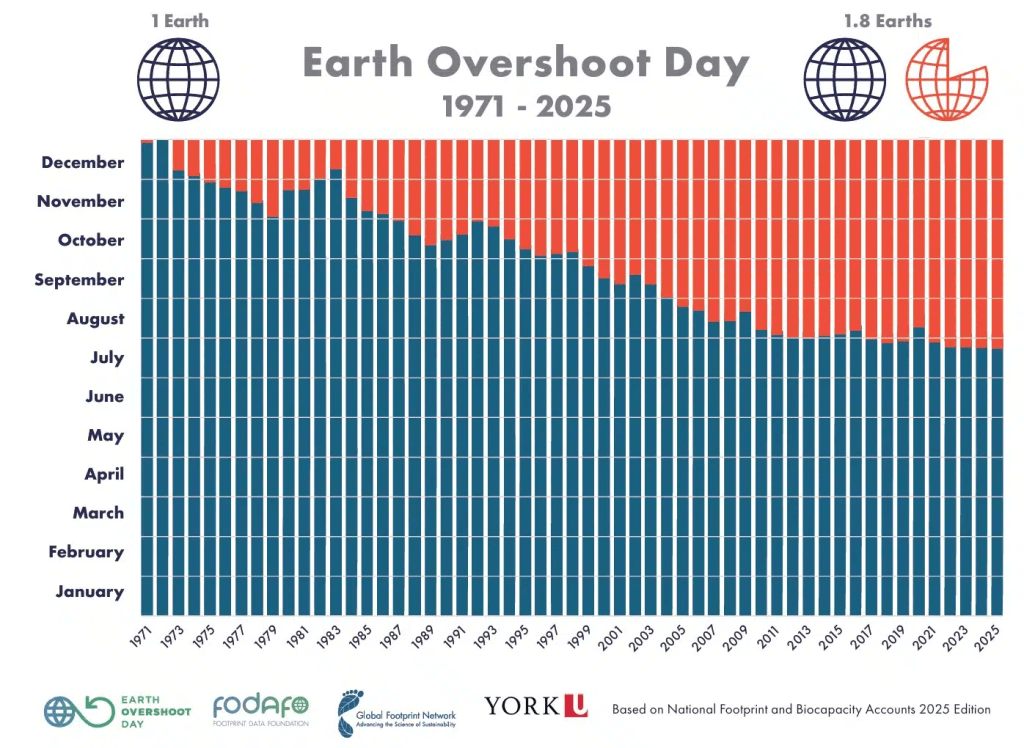
Global Footprint Network, 2025. Earth Overshoot Day. Retrieved March, 2026.
We have a long way to go before our presence produces a net gain for Nature. But it’s well worthwhile tracking our progress.

Leave a comment