
For an Independent Australian Constitutional Monarchy – Or an Elected Governor General?
Here, I outline a process by which Australians can explore the possibility of either a modern constitutional monarchy or an elected Head of State.
Beyond the theoretical concept of an Australian Monarchy, the debate must consider who might fulfill the role of Sovereign. A broad consensus would need to emerge around an eligible Australian family. The current contentions over race may seem a great impediment to this at first, but in time, if nurtured, a clear contender could emerge. There are several issues to consider and a parliamentary committee of inquiry to consider the merits of the process proposed here would be an appropriate starting point.

A Vetting Process
There is a process for vetting potential sovereigns that could be exercised to give them the opportunity to prove themselves in a role that is similar to Sovereign. The exposure would also help determine whether their family demonstrates a readiness to serve. Additionally, it is a process that can bring federal and state Gubernatorial appointments into a coordinated system.
The idea originates from a suggestion for a possible republic in a video by Professor Anne Twomey on her YouTube Channel Constitutional Clarion called Electing the Governor-General. At 17:00 she describes how candidates for Governor-General could be drawn solely from existing and former state Governors (who are willing) to use the existing pool of people who are skilled at regal duties and who are above politics. She suggests holding an election and also toys with the idea of Sortition- Filling Public Office by Lottery. At election time, a brief booklet providing biographical details of each of the candidates would be provided to electors and no ‘unedifying campaigning’ be allowed to avoid a politicized election.
In fact there is already a trend developing in the direction of appointing former Governors to be GG. Three of the last five Governors General were previously State Governors; MG Michael Jeffery (WA), Dame Quentin Bryce (Qld) and Gen. David Hurley (NSW). They were nominated by John Howard, Kevin Rudd and Scott Morrison respectively. Only three Governors General before them had been Governors; our very first, John Hope, 1901-3 (Vic), the 2nd one, Hallam_Tennyson, 1903-4 (SA), and the 10th one, Alexander Hore-Ruthven, 1936-45 (SA). Only Tasmania has not been represented.
Note that state Governors are viceroys of the British monarch, not representatives of the Governor General, nor are they in any way answerable to or even connected to the GG. They are appointed on the advice of the state Premier by the King quite separately to the federal vice-regal position. Therefore, if a referendum were held to replace the Governor General with an elected President, the state Governors as vice regal representatives would still be in place. Only the Northern Territory Administrator is appointed by the Governor-General by Commission under the Seal of Australia in accordance with the provisions of the Northern Territory (Self-Government) Act 1978. The Administrator holds office during the pleasure of the Governor-General. For the same to apply to the states, each state would probably need to hold referendums to amend their constitutions.
Federal/State Coordination
The procedure suggested here of vetting candidates for Governor General would bring the state and Commonwealth viceregal offices into a coordinated domestic relationship while at the same time allowing the public to explore the options of an elected Governor General or a constitutional Monarch over an extended period of time. Nothing in this procedure requires a change to the federal constitution. It requires adoption as political convention.

Currently, Governors and Governors General are nominated by Premiers and the Prime Minister respectively. This has led to some inappropriate and dubious appointments of former political colleagues and allies. It has also led to a politicization of the Crown as the republic versus monarchy debate progresses. The Australian Monarchist League has suggested that these nominations be made jointly with the Opposition Leader. This should also apply to nominations made by state governments to bring some bi-partisanship to the process of appointing Governors General and Governors. Indeed, this reform would be an improvement on the current arrangements whether or not they are intended to lead to a constitutional monarchy or an elected Governor General as Head of a ‘republic’. That is the first step in this process.
Parliamentary CommiTTEE
A Parliamentary Committee of Inquiry, guided by terms of reference defining its purpose, could evaluate the merits of the process proposed here. It would provide a forum for education and debate. The committee would develop a criteria for gubernatorial candidature. Among them would be that the candidate is Australian-born, be willing to serve, be representative of the Australian people, be sufficiently familiar with constitutional matters and have demonstrated skills in diplomacy. Members of the public could submit suggestions to the process and nominate candidate families who would qualify as potential dynasties.
Who might the public suggest in their submissions? With the field wide open, famous, meritorious Australians such as Australians of the Year, former Governors and Governors-General, popular sports figures, notable artists, scientists, academics, former senior military figures, members of former political dynasties, leading Aboriginal Australians, British Australian aristocrats, elite families and community leaders could be expected.
These submissions would give an indication of where public sentiment lies and inform the nominations that state Premiers and Opposition Leaders make to the King for appointment as Governors. The submissions would provide the public with an avenue to inform Premiers and Opposition Leaders of nominees they would like to see considered. These Governors (those who are willing) could in turn then be either nominated by the Prime Minister and Opposition Leader to be appointed by the King to become Governor General, or be listed as candidates for election as Governor General, the winner then being appointed by the King.
A Coordinated Domestic Relationship
Prof Anne Towmey did a PhD thesis in which she tried to address the issue of “The States, the Commonwealth and the Crown—the Battle for Sovereignty*” Papers on Parliament No. 48 January 2008. Commenting on the effects of the Australia Act (1986) (which I maintain should have gone to a referendum) whereby the states have been able to by-pass the British government and directly advise the monarch on state matters, she states,
“Ultimately it’s up to Australians to decide. It’s a matter of trying to achieve some sort of consensus as to what it is that was created. Now that leads to all sorts of difficulties when you come to a republic, because if you’re not absolutely sure what you’ve got, you don’t know quite how to change it. If you only have one queen and you get rid of her, then automatically there is no queen in relation to each state, unless you actually had a republic referendum that had the effect of abolishing one queen and creating six, which would just seem a little bit silly. So that’s one possibility. The other possibility is to say that the states retain their connections to the Queen: that there were separate Crowns and that each state was left to deal with it. Now in the 1999 referendum, that was the view that was taken that each state would be able to retain its own Crown and break up relationships later but I think that’s something that needs a lot more thought and a bit of consensus-building.”
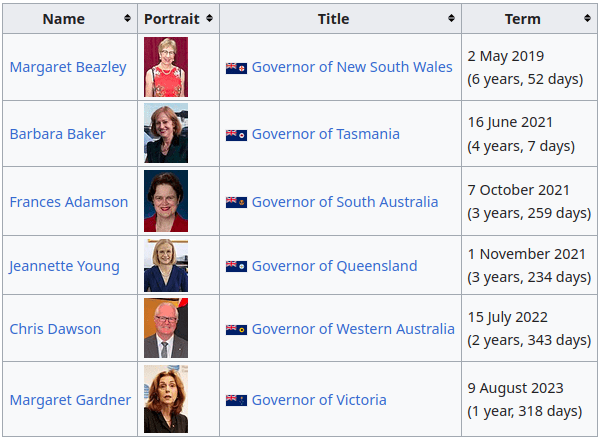
The process suggested here provides an opportunity for consensus-building. It will also give the states an experience to draw on from which they may propose their own referendums on the appointment of their Governors. Section 109 of the constitution states that where there is inconsistency in state and federal law, federal law prevails. However, the appointment of state Governors is not addressed in the Commonwealth constitution. In fact, at Federation, the Colonies chose not to be subordinate to the Governor General, as is the case in Canada, and so they retained a direct relationship with the British Crown via the British government. Therefore, each state can, presumably, independently decide whether or not to sever ties with the British monarch and enter a coordinated domestic relationship that transfers the authority to appoint Governors (on the advice and nomination by both its Premier and Opposition Leader) to our Head of State.
Imagine the custom developing of the heir to the throne being nominated by the Premier and Opposition Leader of NSW and ceremoniously appointed by the King or Queen to be Governor of New South Wales and therefore also becoming the Prince, or Princess of New South Wales.
Every culture has its rituals. This process would be a very rich, tried and true way for public opinion to evolve with experimentation that arrives at an arrangement with broad appeal. It is far preferable to a crude referendum on becoming ‘a republic’.
A Referendum
Naturally, this process would evolve over time and its direction would be determined by pubic opinion, which would probably involve a number of plebiscites at both state and federal levels. The outcome it reaches is uncertain, in terms of our Head of State arrangement, but Australia’s relationship to the British Crown will continue to underscore it until a referendum is held.
Where the above process leads is uncertain. It could settle into a pattern of bipartisan nominations without severing ties with the British monarch at all. It may go further to where most or all states transfer authority to appoint Governors to the Governor General. It seems inappropriate to proceed to the next step until every state has done this. Ultimately, it may culminate in sufficient support for a plebiscite or plebiscites to decide on the final form of government at the federal level. Plebiscites are used to present several options, while a referendum is used to offer one change to the status quo. The plebiscites would test support for either formally establishing an elected office of Governor General as Head of State of an independent Commonwealth of Australia or an independent constitutional Australian monarchy. Were the latter option preferred, another plebiscite would probably be needed to choose among leading candidates representing families who would become a domestic dynasty. The result of that plebiscite would form the basis of a referendum to formally change the constitution to transfer the British crown to an Australian dynasty.
A Glorious Revolution
The Glorious Revolution of 1688 confirmed the primacy of the English Parliament over the Crown. It deposed James II (because he was an unpopular Catholic) and bestowed the crown on Mary who was next in line, an Anglican and married to Protestant William of Orange. There were other Euro-political reasons, but the precedent underscores the Australian parliament’s power to transfer the Crown from King Charles III to an Australian claimant to the throne.
Credentials For A Monarch
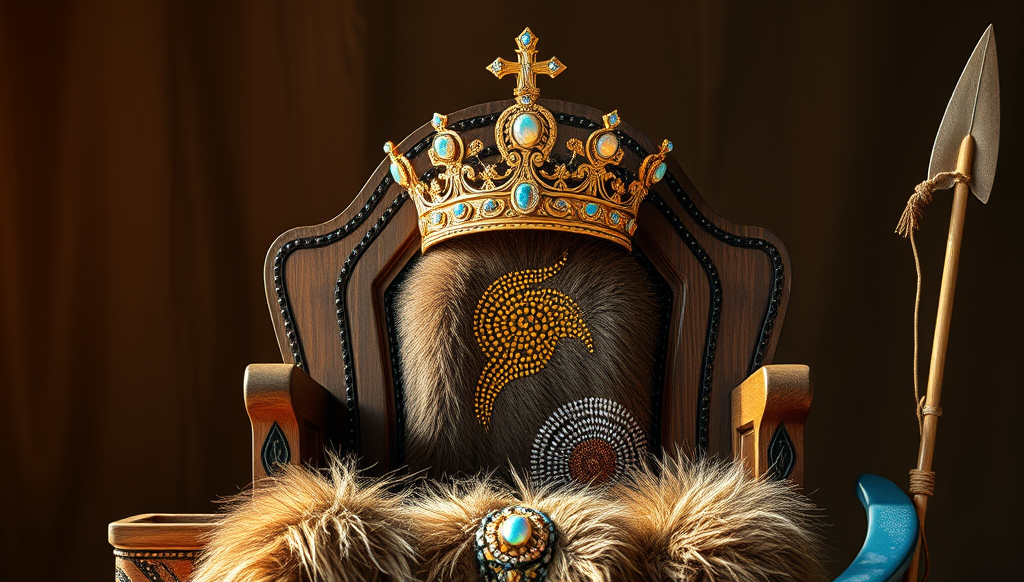
The vetting process described above would provide members of potential dynasties with the necessary exposure, skills and experience required of a monarch. In time, a clear contender may emerge.
An important concept in monarchy is lineage. In the past, it was entwined with the divine right of Kings to rule. Today it is what ensures stability and continuity. Rules of succession in various forms have guided European royal houses and their parliaments for centuries. Legitimacy (born in wedlock) is an element in those rules. There are a number of Australian Peers (Dukes, Marquess, Earls, Viscounts and Barons) and some of them can trace their lineage to the Royal Family. A few even have claims to the throne of England. This seems like a logical starting point, so I have created a list of these peers who were born in Australia and put them in order of most interest and given an indication of their potential.
List of Contenders
| Contender | Claim/Merit | Experience | Willingness |
Lord Simon Abney-Hastings, 15th Earl of Loudoun | Legitimate heir to the English throne down the Plantagenet line of succession. In 2004, the television documentary Britain’s Real Monarch presented evidence that his father, the 14th Earl, was the rightful King of England. Recent DNA and archeological studies at the University of Leicester further substantiate the claim. | Born in rural N.S.W., Australia in 1974. He lives in Sydney. He succeeded his father to the title in 2012, and in 2023 bore one of the two golden spurs in the procession into Westminster Abbey at the commencement of the Coronation of Charles III and Camilla. Currently unmarried. | Unknown. He is a Patron of the Victorian Branch of the Australian Monarchist League, and has a long list of other Patronages and Honours. The heir apparent’s willingness is unknown. |
Mr Simon Dorante-Day | Illegitimate child of King Charles III & Queen Camilla. Evidence based on dates and his grandmother’s assertion. Winifred and Ernest Bowlden were former workers at the Palace for the Queen and Prince Philip. Ernest Bowlden was honored with an Imperial Service Award for his work for the Queen (MEAWW). Simon was born on April 5th 1966 and adopted out 8 months later. Born in Gosport, Hampshire, UK. Hometown Drayton, Toowoomba, Queensland, Australia. Simon seeks DNA proof but dismisses ancestry tests citing security risks (FB). | Born in England, grew up in Portsmouth to age 17. Springfield Comprehensive School, Drayton. Migrated to Australia by himself in 1987, aged 21 after 3 years in the Merchant Navy. Married to Aboriginal Dr Elvianna Durante-Day. Father of nine. | Appears to be determined to take his place in the line of succession. |
Lord Kimble Montagu | Heir presumptive to the dukedom of Manchester. (Dukes rank above Marquess and Earls.) | Australian citizen. An academic in marketing at Monash University. | Unknown |
 Lord Dunmore: Malcolm Murray, 12th Earl of Dunmore, | Born in Tasmania in 1946, and has lived there all his life. | Has been very active in retirement; made a speech in the House of Lords (maiden and last due to changes to legislation 1999). High Commissioner of Clan Murray in Australia and many other works and activities. | ”We probably wouldn’t survive a life of privilege.” (Otago Daily Times) |
| Lord Lincoln: Robert Fiennes-Clinton, 19th Earl of Lincoln | Head of a branch of the Fiennes-Clinton family | Raised near and lives in Perth, Western Australia. Elected a Fellow of the Zoological Society of London in 2013 and is an honorary member of the WACA. | Unknown. Appears to be unwilling to have a public profile. |
| John Francis Blackwood, 11th Baron Dufferin and Claneboye | An Australian architect and a peer in the Peerage of Ireland. | Educated at Barker College, Hornsby, New South Wales, and the University of New South Wales. Went into private practice as an architect in Orange, New South Wales, and by 1984 was listed as ARAIA Married Annette Kay Greenhill, a daughter of Harold Greenhill. They have two children, Freya Jodie (born 1975) and Francis Senden Blackwood (born 1979), heir apparent to the peerage. | Does not use his titles professionally. |
Australia is quite polarized on social issues. An idea that progressives suggest is an Aboriginal monarch, to solve what they see as the unresolved issue of sovereignty. It should be noted that there are no racial barriers to who the Sovereign marries. Therefore, it is best to let fate (and love) determine that element of the monarchy. If I were to nominate a family with Aboriginal heritage, it would be the patron of Sustainable Population Australia, Professor Anne Poelina’s family. She is a Nyikina Warrwa woman from the Kimberley region with Indonesian ancestry. Her son by Australian Gary Proctor, is actor Mark Coles Smith who features on SBS’s Who Do You Think You Are?

Featured Contender
A little known fact is that we have an Australian-born claimant to the throne of England; Simon Abney-Hastings. Simon is officially the 15th Earl of Loudoun and was born in Wangaratta, NSW, in humble circumstances.
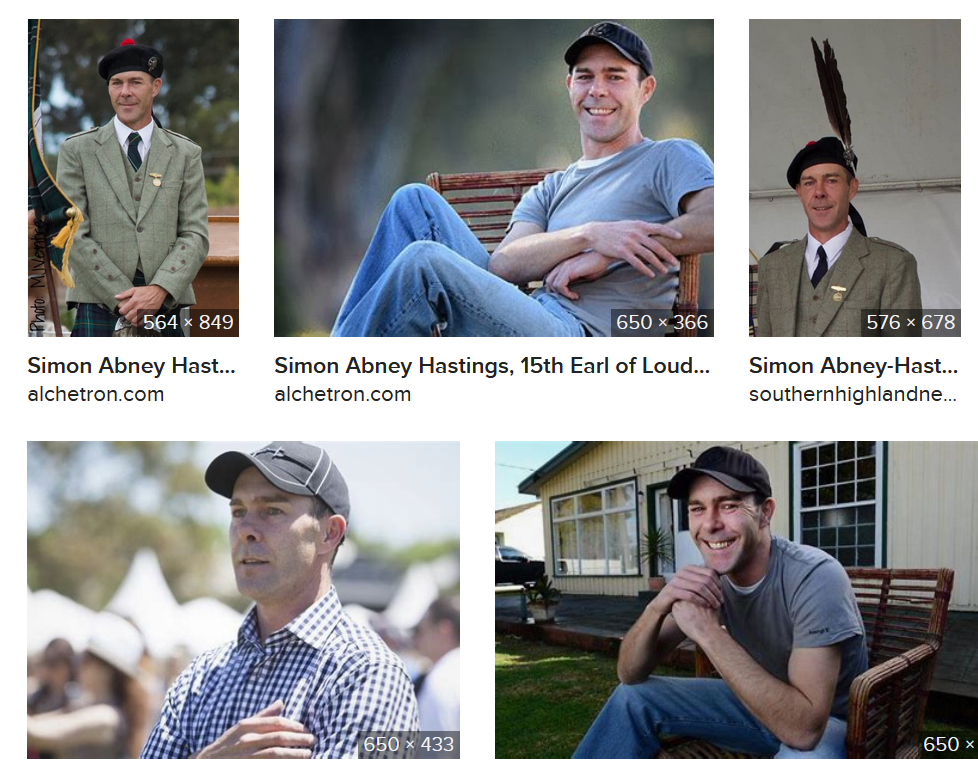
In 2004, the documentary Britain’s Real Monarch repeated the claim that Michael Abney-Hastings [Simon’s father], as the senior descendant of George Plantagenet, 1st Duke of Clarence, was the rightful King of England. This argument hinges on the claim that Edward IV of England was illegitimate.[7] Simon Abney-Hastings, following his father’s death, would have become the rightful monarch of England under this alternative path of succession, rather than Elizabeth II, and would be the current monarch rather than Charles III. Abney-Hastings has recognized his right to inherit the throne of England. However, he has stated he is a loyal supporter of the late Queen and her eldest son.[8] He was invited to the coronation of King Charles III, notwithstanding the competing claim being occasionally discussed by some media sources.[5]
Simon’s competing claim could be resolved through a regal secession in which he renounces his claim to the English throne in favour of an Australian throne.
Who would you nominate as a Governor, who could become the Governor General or Monarch?
