
Contents
- Contents
- The Case For a Great New Northern Australian State
- Developing The North
- The Politics of Capricornia
- Summary
- Have Your Say
The Case For a Great New Northern Australian State
IT’S TIME
Australia’s northern state and territory borders are an afterthought of federation. Meanwhile, we’ve all moved on, the climate is changing and so is our population. An opportunity to adapt to living on this continent presents itself, not to increase our presence, but to maintain it and improve it. To achieve this, the powers of a state government are necessary to coordinate the resources and people across the entire north of the country and secure proper representation in the Commonwealth. The Capricornia project gives Australia a new sense of purpose and an opportunity to reinvigorate our great country. It’s time we gave our attention to the borders of the Northern Territory, the Kimberley Region and north Queensland.

IMPROVING THE FEDERATION
Is there room to improve the Commonwealth?
There have often been complaints that Australia has too many politicians per head of population and that we are over-governed. There have been calls to ‘Shed A Tier‘ of government and cull bureaucracy in order to reduce expenses and streamline decision-making.
There are numerous examples of Local Government Authorities amalgamating across the cities of Melbourne, Brisbane and the state of NSW. The creation of the Greater Brisbane City Council in 1925, which celebrates its centenary this year, saw the country’s biggest local government come into existence. It has a larger budget and population than the state of Tasmania and the Lord Mayor is elected along the lines of a President. The results of these amalgamations appear to be mixed. I’m not aware of any attempt to systematically evaluate their success.
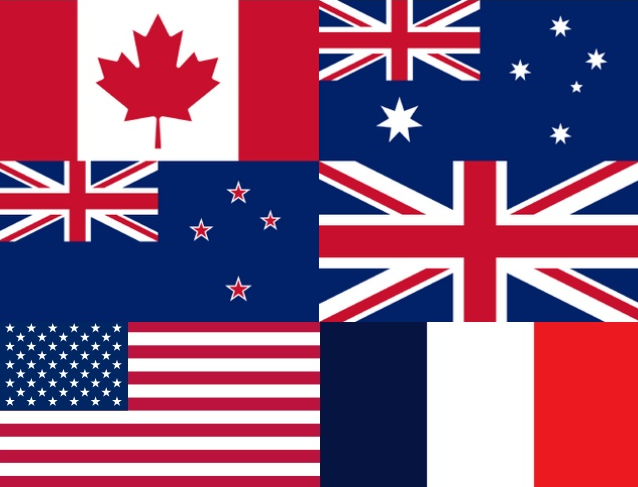
However, Australia’s Federal system is not as over-administered as many believe. Federated states such as Australia, Canada and the U.S.A. are, according to Professor Twomey, more efficient and cost effective than unitary governments such as New Zealand, France and the U.K.. This is because decisions are delegated to those most affected and who are closest to local conditions and therefore best informed. For example, as Professor Twomey explains, in the 1970s, before the Northern Territory had self-government, a hospital was built in Darwin, the design for which was chosen by administrators in Canberra. The design suited Canberra’s climate and was inappropriate for the tropics.
The powers of the Commonwealth government have grown since Federation in 1901. There are many arguments back and forth about the balance of powers between the states and Commonwealth. The states have jurisdiction over regional services such as schools, health, police and transport, while the Commonwealth controls finances (Medicare, income and corporate tax, royalties, banking, etc.), defense, foreign affairs, immigration and welfare, etc.. While the states get some revenue from their taxing powers, the Commonwealth government manages the distribution of the nation’s revenue to the states. Where the money goes is an on-going bone of contention at Cabinet meetings that bring the Prime Minister and all the Premiers together. The resource-rich states of WA and Queensland and populous states of NSW and Victoria give up some of their revenue (GST for example) to prop up other states such as Tasmania. It is the Commonwealth’s role to reallocate revenue for the good of the country as a whole. This is the system that would manage the resources, revenue and funding arrangements between the existing states and a new northern state of Capricornia.
In this article, I focus on one aspect of Federation; the distribution of state and territorial jurisdictions across the northern part of the country. It is certainly not the first time anyone has toyed with the idea, but nobody appears to have thought of this one.
WHY ‘CAPRICORNIA’?
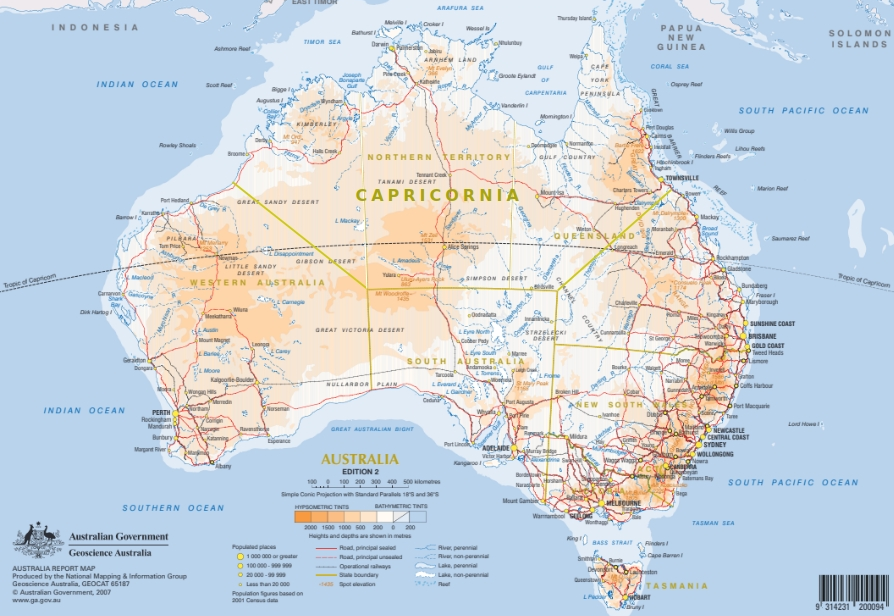
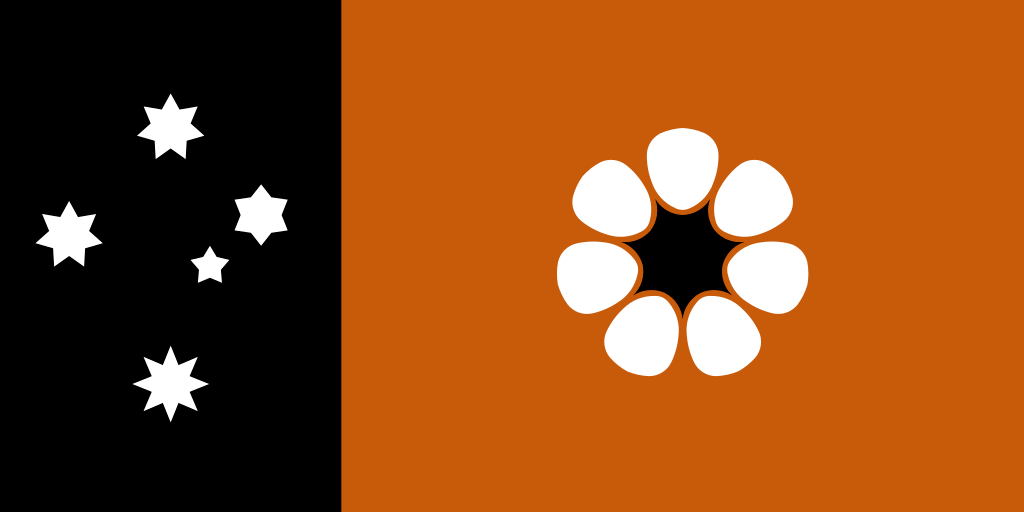
I’ve chosen the name Capricornia because the Tropic of Capricorn is, as you can see from the map below, the defining feature that affects the state’s climate, geography, ecology and lifestyle. It is more interesting and distinctive than a name that references the rest of the country, like ‘North Australia‘ and it avoids social politics. Capricornia was the proposed name of a north Queensland state as recently as 2004. A decision on the name (and flag) may need to be decided by a plebiscite.
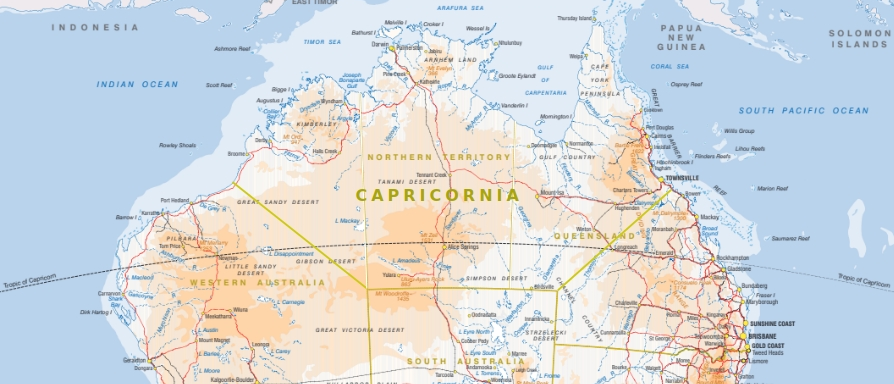
THE BORDER HISTORY OF THE NORTH
The current state and territorial borders of the north evolved from decisions made by colonial administrators in Sydney, London and to some extent the fledgling settlements that were being established across the continent. They drew borders on a map that divvied up the continent between major cities that would act as centres of administration. The borders were more or less equidistant from these centres. This was part of the British strategy of claiming the whole continent before any other European power could. Darwin was the most challenging settlement to establish because of its climate and remoteness from the other major settlements in the south. As far as the federation is concerned, the north is something of an afterthought.

The borders were subject to considerable change up until the 1930s after the Imperial Conferences where Australia’s federal government gained more power over internal affairs. Power devolved from London and border changes slowed down as the process involved more local consultation. For a more comprehensive history, click HERE.
Much has changed since these borders settled into their current position. We know much more about the land, the people and resources. Cities like Mt Isa have grown up around mining while others like Cairns, Katherine and Kununurra are tourist, transport and agricultural centres. Many Aboriginal groups have established Land Councils on Native Title land across significant parts of the tropical north and arid centre.
In as much as past state border delineations have been based on a principle of proximity to a centre of administration, Queensland and Western Australia are anomalous.
CAPRICORNIA’S BORDERS
The proposed state of Capricornia, by incorporating the Kimberley and northern Queensland, supports the principle of proximity if Darwin is the capital. Proximity is a concept affected by geography, existing transport and communications infrastructure and emerging technologies.
Our island continent’s shape and its position on the globe sits almost perfectly balanced on an east/west axis, the widest point being on about the 27º south latitude (Cape Byron in the east = 28.63509º S, Steep Point in the west = 26.152283º S). Were the eastern and western borders of Capricornia to meet the coast at exactly 19.43º S, they would be at Ex Anna Plains in the west and at Cromarty in the east, on the southern border of the City of Townsville.
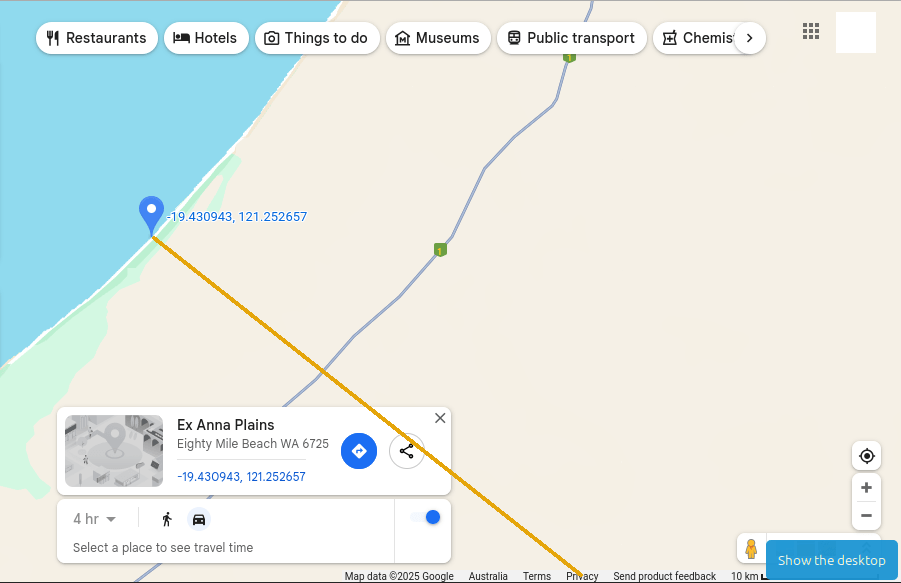
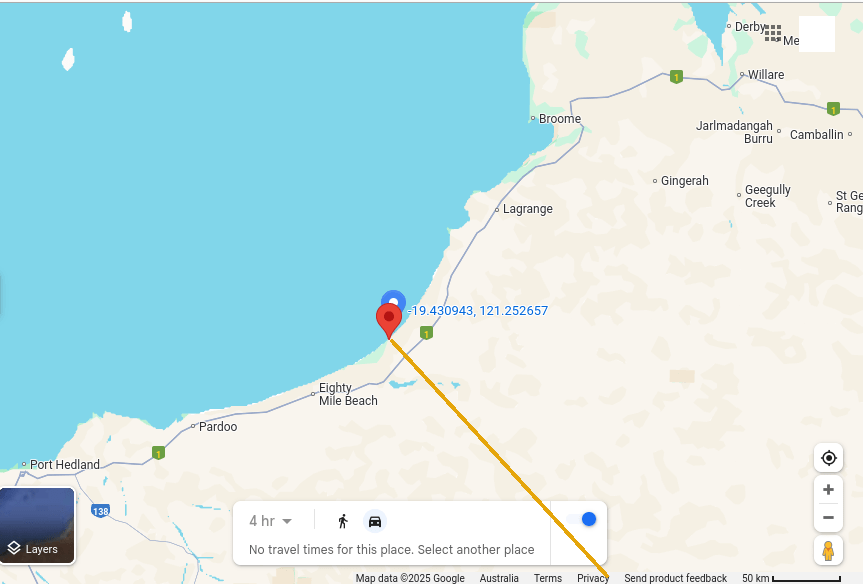
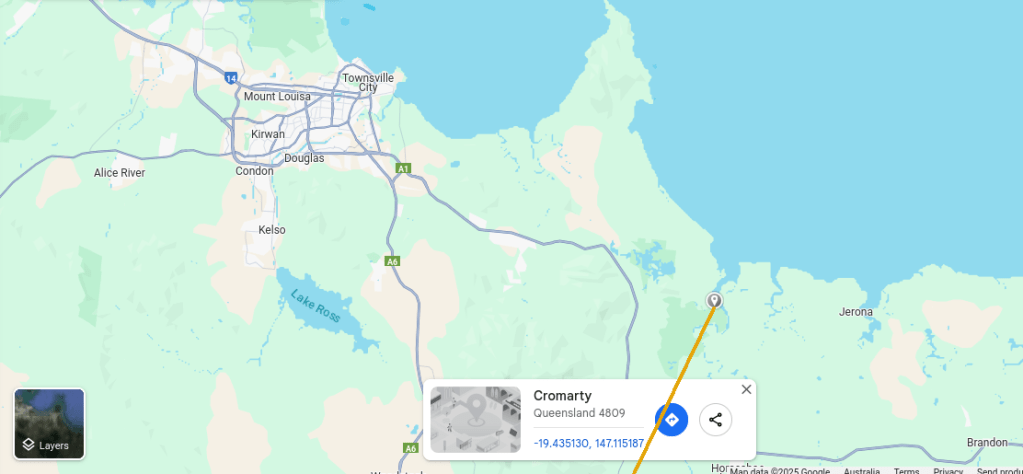
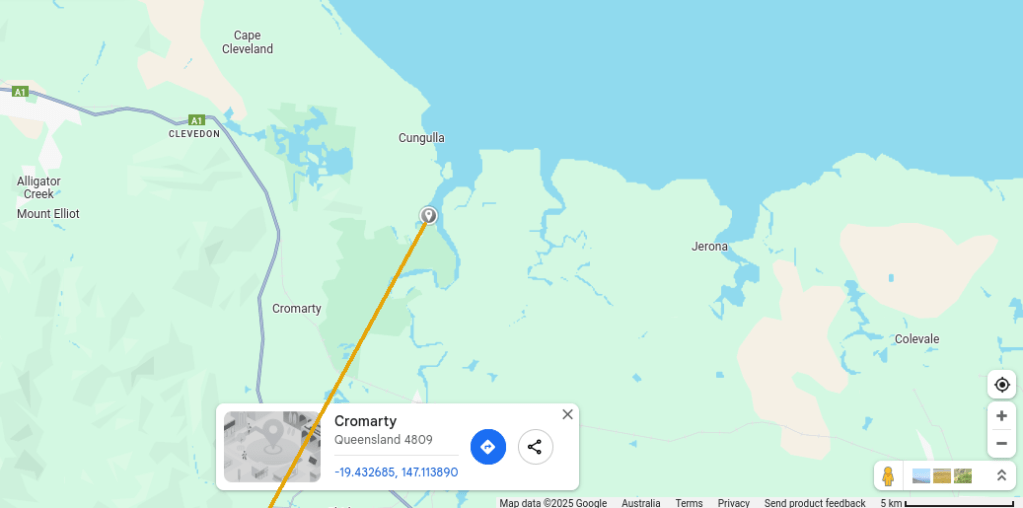
These ‘beautiful’ borders – apart from being ‘beautiful’ on a map – are arbitrary, of course. Many other considerations will need to be taken into account. In Queensland, LGA boundaries follow more or less along the straight line border from the north east corner of the SA border right across to the coast (see Queensland). In Western Australia, the LGA borders are less agreeable, cutting the Shire of East Pilbara in half, a 3rd off the Shire of Ngaanyatjarraku and sliver off the Shire of Broome.
Broome, Derby and Kununurra are closer to Darwin than to Perth. They are also separated by a vast barren region (the Gibson and Karlamilyi deserts) from the south west of WA (more on this below). Nonetheless, the straight line border cuts through several shire and Aboriginal Land Councils. Also, where the sentiments of the residents of Broome lie and where mining resources are in the Pilbara will contribute to the debate.
The division of north Queensland from the rest of the state is no less complicated – perhaps more so – than Western Australia’s division. Mount Isa and Burketown are closer to Darwin than Brisbane, as are Port Douglas and Cooktown (by air), but Cairns and Townsville are closer to Brisbane. Although there is no natural geographical feature separating north from south (other than the Tropic of Capricorn), there are political agitations in north Queensland for secession that are not in evidence in Kimberley. Some of these agitations run along electoral and LGA (Local Government Area) borders that may establish a state border. They are long-standing, dating back to the 1890s. More on this below (see The Politics of Capricornia) and in the History of North Australia’s State Borders.
These borders would create the largest state by area in the country at 2,886,000 km2. This is 240,000 km² larger than Western Australia’s 2.646 million km². By far the largest contribution comes from the Northern Territory (1.42 million km²). Queensland’s portion would comprise 670,240.8 km² (Far Nth – 380,748.3 km², Nth – 80,041.5 km² & 1/3rd Central – 209,451 km² [Diamantina – 94,731 km², Winton – 53,814 km², Boulia – 60,906 km²]). WA’s portion would comprise 597,555.5 km² (the Kimberley, most of the Great Sandy Desert and half of the Gibson Desert or Pilbara).
Capricornia would be larger than WA was and replace it as the largest state. WA would rank 2nd largest at 2,049,000 km², SA 3rd at 983,482 km², Queensland 2nd at 858,000 km², NSW 5th at 801,150 km², Victoria 6th at 227,444 km² and Tasmania 7th at 68,401 km².
Creating a new state larger than WA with only the 6th largest population, smaller than SA, runs contrary to the requirements of a sufficient tax base to support the infrastructure and public services of a vast area. For this reason, reconfiguring the borders would be advizable.
Developing The North
We have not properly tapped into the potential of the north. In recent years, as evidence of drying and warming becomes more apparent in the south east and climate change makes it onto the political agenda, there has been talk of developing the north.
The Abbott–Turnbull government is no exception, going to the 2013 election with a specific northern Australia “vision” document, publishing a white paper in June 2015, establishing the Northern Australia Infrastructure Facility (NAIF) and assigning ministerial responsibility for northern Australia.
Australia Institute -Matt Grudnoff & Rod Campbell, Discussion paper, 2017
The north is a lot wetter, albeit hotter region of the country. Attempts have been made (and to some extent succeeded) in utilizing this water to boost agricultural output in northern Queensland and notably along the Ord River.
Lake Argyle, together with Lake Kununurra, is part of the Ord River Irrigation Scheme. There are currently some 150 square kilometres (58 sq mi) of farmland under irrigation in the East Kimberly region.
The Ord River Scheme is a lesson in adapting to the tropical north:
Like so many other experiments in tropical agriculture, the scheme initially failed because of difficulties growing crops and attack from pests. Today the irrigated areas successfully produce a variety of fruits and vegetables, with the most recent crop being sandalwood.
Wikipedia
Grudnoff and Campbell emphasis “enterprises that are commercially viable, sustainable and generate employment and other benefits for northern Australian communities.” Investment is needed directly in services and infrastructure to retain existing populations and attract new people and businesses. Health, education and transport infrastructure as well as communication infrastructure – mobile phone reception, access to internet, high-speed broadband – are also likely to generate direct benefits for communities. “Investing in the Indigenous community should also be a focus for northern development. There are enormous social and economic benefits from programs such as the Indigenous Protected Area and Indigenous Rangers schemes, which provide training and employment for indigenous people in environmental management. Cost benefit analyses of indigenous social programs consistently show that they provide large net economic benefits.” They warn against capital intensive projects such as the Ord River Irrigation Scheme, which indeed may have been an example of the big guns from Canberra coming in with big ideas that should have been initiated by better informed, local authorities, such as a state of Capricornia.

Darwin and Melbourne based Spee3D‘s CTO Steven Camilleri has produced a Blueprint to Reinvigorate Australia’s Economy (APDR). It is a clarion call to doing things better with what we have and making stuff here:
Myth: “We don’t have the population to sustain high-value industries.”
Reality: Population size is irrelevant. Strategy matters. Israel (9.2 million people) dominates cybersecurity, defence, and medical innovation. Singapore (5.6 million) exports $33,000 per capita in high-tech goods. They didn’t wait for size – they built success through smart investment (see Figure 1). It’s true that Australia has a small domestic market, but countries like Singapore have relied on their ability to collaborate across government and industry to overcome their smaller local market potential and seize on significant export opportunities instead.
Camilleri points to political indecision, short-term cycles, lack of government collaboration and long, complex debates as obstacles to our achieving our potential for greater self-sufficiency, as Donald Horne also lamented. Worldwide, we rank very low (18th) on national self-sufficiency. The United States ranks as the 4th most self-sufficient nation. If we are to look up the U.S., it should be with admiration in this regard. Camillari calls for more leadership and vision in government. A state of Capricornia represents a far better arrangement of state jurisdictions across the north for government to play its part in Australia’s future.
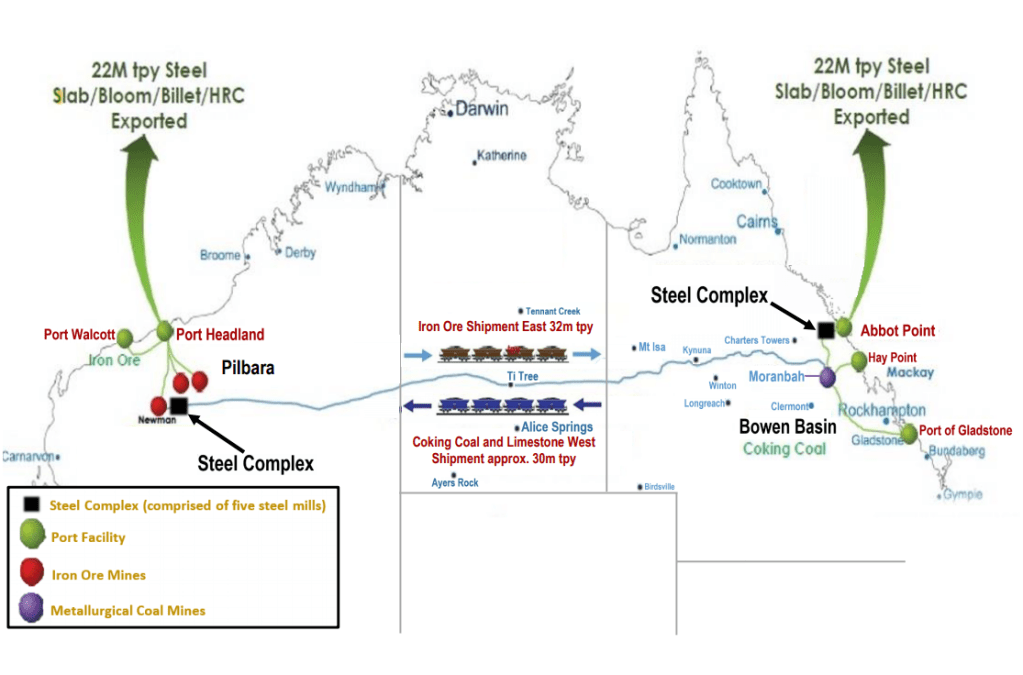
A cursory look at the road and rail network across the north provides evidence of how the NT government has been held back by inadequate funding and scope. In Queensland, there are complaints from mining companies about the cost of accessing the government QR rail network, putting some companies into liquidation (ABC). East West Lines Park‘s Iron Boomerang Project is ‘a transcontinental multi-user rail infrastructure corridor and steel manufacturing complex’. The majority of its length spans Capricornia from Pentland to the Pilbara. The Georgina Basin would be entirely within Capricornia, adding to the state’s economy and viability. The IBP opens up Capricornia’s critical minerals resources. It could link up to a circle of rail right around the country.
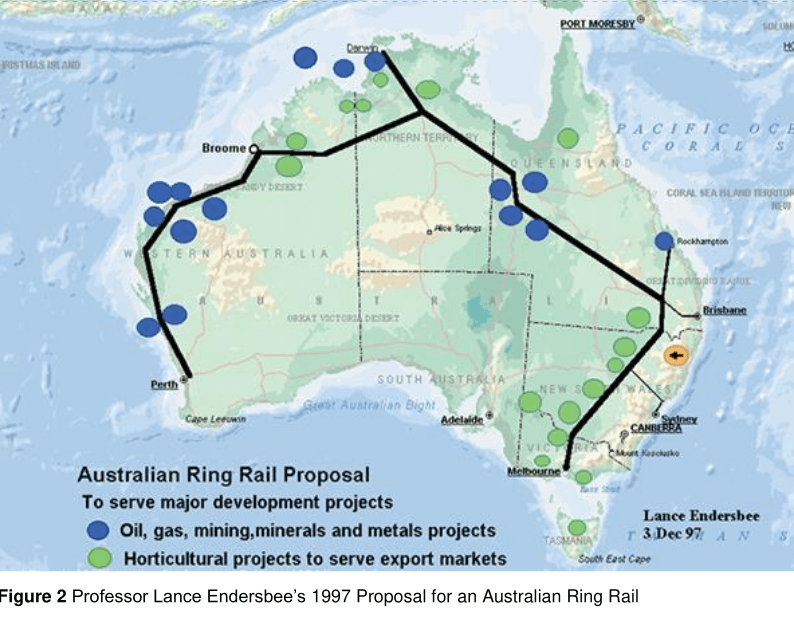
The road network across the central north is somewhat dislocated and could be improved in conjunction with the IBP. From maps showing suggested routes, the line could join Winton in Queensland to Boulia and then on to Tea Tree in the NT and right across to Newman in the Pilbara. Connecting Tennant Creek and Halls Creek (which is having trouble feeding itself) would cut many hours off the east/west journey between Mt Isa and Broome. This would also provide a more direct route right across Capricornia to Townsville. Similarly, Birdsville and Alice Springs are cut off by the Simpson Desert. A promise to connect The Alice to Birdsville and Boulia via Bedourie and improve the road between Winton and Hughenden may very well entice the shires of Diamantina, Boulia and Winton to join Capricornia. Transport technologies are advancing and more options are coming online that could be supported by airports across the region. Investing in constructing better connections would bring these remote communities closer together.
Australia is the driest inhabited continent on Earth. Yet we have the technologies to live comfortably in arid areas. Atmospheric Water Generation machines extract water from the air even in arid areas. Start Scientific is an Australian company that is a leading innovator in hydrogen fusion using a cold catalyst to release the energy from the recombination of hydrogen and oxygen. Hydrogen powered transport may not produce much water, but in the outback, every little bit counts.
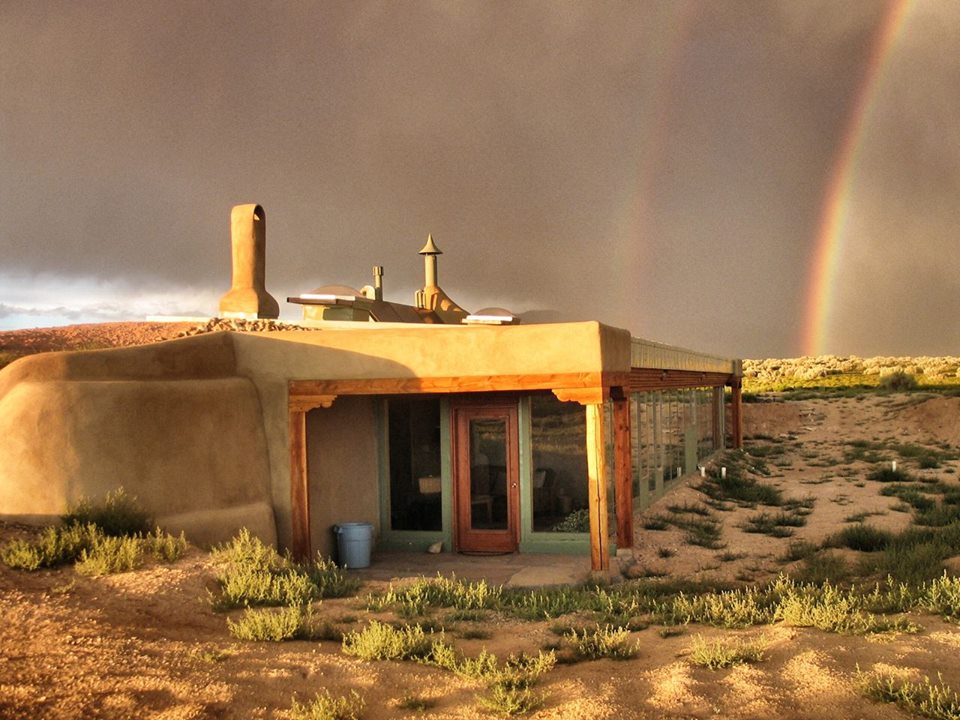
Energy efficient building designs suited to arid areas are already available that take advantage of the abundant sunlight.
Many people may view development of the north as a way to boost GDP. However, GDP as a measure of human well-being is losing ground to concepts such as GPI (Genuine Progress Indicator). Development means improving the quality of people’s lives. Somewhere between over development and underdevelopment is a sweet spot in which everyone has enough and the environment is healthy. It is not stasis, but a condition of balance within which we are able to continue investigating our potential and pursuing fulfillment.
Uncomfortably hot as the north already is for many, migration there from the south is more advizable than geoengineering water diversion to the south. The scale and expense of schemes such as the Bradfield and Argyle Lake, designed to direct fresh water river systems to the south are such that a policy of regionalization of the population is much more feasible. Fast rail connecting Brisbane, Sydney, Canberra and Melbourne is more likely than these northern water diversion schemes. Keep in mind that Australia’s defence strategy is predicated on deterrence by denial because “defence by punishment or retaliation, are probably well beyond Australia’s resources.” (CSIS) Australia needs to strike a balance between the size of its population and the demands it creates and its capacity to provide for itself without undue reliance on other economies and powers. Providing infrastructure and energy to support adequate air conditioning for a larger population in the tropics is more feasible. Empowered by a slightly larger population, the state of Capricornia would have the power to coordinate development. Passive building design techniques ensure energy and technology requirements are minimal. Capricornia water resources, both above and below ground will be the envy of the other states, but a policy of regionalization makes far more sense than redistributing water.
CLIMATE CHANGE
Developing the north is an appropriate response to global warming.
Whether or not we agree on the causes, the southern states are becoming hotter and drier. The north is likely to get warmer and wetter. It is important to understand that temperature changes are greater at higher latitudes. In other words, the southern parts of the continent will experience greater warming than the north. An increase of 1 degree Celsius at the equator translates to a 12 degree increase at the poles.
Australia’s water security is becoming more precarious. The populations of the major cities in the south are already beyond their natural hydrological carrying capacity (Big Thirsty Australia). More than 6 desalination plants have been built at the major capital cities since the turn of the millennium. There is little mention in mainstream media and even alternative media of the increasing cost of water delivery to customers that this causes, not to mention the precarity caused by increased complexity and supply chain vulnerabilities.

Many will argue for development in the north to increase the country’s population. However, post industrial countries like Australia naturally experience a temporary period of fertility decline until the population settles into a ‘new normal’ balance of low births and deaths. This is generally beneficial because with a smaller population there is more to go around. Fears of a labour force imbalance are unfounded.
The massive housing and property building era between the decades 2005 – 2025 was driven by hasty, engineered population growth (immigration). It saw little time for quality design and construction and little thought was given to energy efficiency and materials that would last. Over the next generation or two, this urban sprawl and inner city densification across the southern metropolises will fail the test of time. Much of it will need to be reworked to adapt to new conditions. For example, the fields of cookie-cutter, dark-roofed, yardless houses will need to be mined for materials as they deteriorate. In other words, we’ll need to scavenge from buildings and recycle materials to maintain existing structures. Choices will be made about staying or leaving these suburbs. A degree of depopulation is likely as property values fall. Only the lucky few debt-free home-owners who genuinely care for their characterless houses will stay. They will enjoy a better environment as dilapidated structures are replaced by parks and gardens. Others may chose to move north.
REGIONAL RELATIONS
Pacific Islanders facing rising sea levels could be relocated and become a part of the north’s development. This could be both a distributed presence with cultural merging or the identification of a ‘new homeland’ location (Burketown’s ‘Plains of Promise’?) in consultation with all parties involved.
DEFENSE AND SECURITY
A neglected north is a defense vulnerability and an economic, trade and tourism opportunity missed. Developing the north would signal to the region that Australia recognizes the importance and value of its northern reaches. Capricornia is a strategic priority for Australia in terms of its proximity to our Asian neighbours. “Australia faces the most complex and challenging strategic environment since the Second World War” (Ministry of Defense). In response to this new reality, Australia is building up its defence forces (hence AUKUS and the purchase of new submarines). The new 2024 National Defense Strategy “is a blueprint to deliver an ambitious transformation of the Australian Defence Force (ADF) to an integrated, focused force capable of safeguarding Australia’s security” and “contributes with our partners to the collective security of the Indo-Pacific” (MoD). Nevertheless a Strategy of Denial persists. (CSIS).
Australia’s northern coastline is strategically important to national defence. Darwin hosts a substantial airbase which is being expanded to accommodate military forces from the United States, drawing Australia into external conflicts. By developing our domestic capabilities and by avoiding being unnecessarily embroiled in overseas wars, we have a better chance at a defence force that is genuinely defence -oriented. We should be focusing our best minds and efforts on military technology that creates an iron shield because, after all, destroying incoming missiles is like trying to shoot a bullet with a bullet. The current Trump Administration does not favour bearing the burden of our defence.
In recent news, the Northern Territory government is reviewing its rights over Chinese-owned company Landbridge’s 99 year lease of the Port of Darwin (ABC).
Coordination across the north of both development and defence by federal and state governments would be better served by a single state entity.
Another issues is that although the government is trying to create a more self-reliant defence force, “Australia is currently experiencing recruiting problems, and the all-volunteer force model is under pressure.” The CSIS says, in not so many words, that the lack of national unity, patriotism and purpose in the general population is holding our defence recruitment back.
Capricornia is a nation-building vision that can foster social cohesiveness and brings into focus the need to simplify the subversive ‘social engineering’ policies of the past. (Subscribe below for more on Triculturalism in later posts).
The Politics of Capricornia
A state needs a number of things to be viable. Constitutional lawyer Anne Twomey, Professor Emerita of the University of Sydney describes some of these issues in her YouTube channel Constitutional Clarion in a video called ‘Queensland and Kingsland – Can you split a state in two?‘ An important prerequisite is economic sustainability. Coal mining royalties in north Queensland would not “in itself be sufficient to establish all the institutional infrastructure needed for a new state and the public services necessary to manage it. The state would have to run its own school system, police, prisons, transport, land management, energy and emergency services etc.. You would lose economies of scale and of course everything costs so much more when you’re dealing with vast, remote areas.” Because of this greater expense, “you would need a really strong tax base to support it, which north Queensland does not have.” Also, she says, coal mining may not be a long term source of riches to rely on. “Secondly, there just isn’t the population to support it.” Also, a new state has to bare the burden of its own debt and maintain its own aging infrastructure. For more on north Queensland’s economic base, watch Townsville Councillor Margie Ryder with Clayton Cook.
Capricornia’s economy would have a much broader base than a North Queensland state. It would be based on ecotourism, mining and resources and agriculture. Coastal communities can be developed as sustainable towns with a focus on marine tourism and conservation, which is what Broome already does. Capricornia would have the largest concentration of Aboriginal Australians (about 18%) and their culture would be reflected in its hybrid identity. The state would have an abundance of national parks offering marine and wildlife preservation and viewing.
Would Capricornia’s population be a large enough tax base to service itself?
POPULATION
Capricornia would have the combined populations of the Northern Territory 255,062, Kimberley 39,389 and the Queensland regions of Far North, North, North West and the western third of Central Queensland* 574,842. Based on the 2021 Census and more recent 2024 numbers the total would be 869,293 people. About 130,393 or 15% identify as indigenous.

Capricornia would have the 6th largest population in the nation – more than Tasmania’s 571,200, which, remember “already struggles financially and with human capacity” according to Professor Anne Twomey. It is larger than the Australian Capital Territory’s population of 474,132. It would have the least concentrated population of all the states and territories.
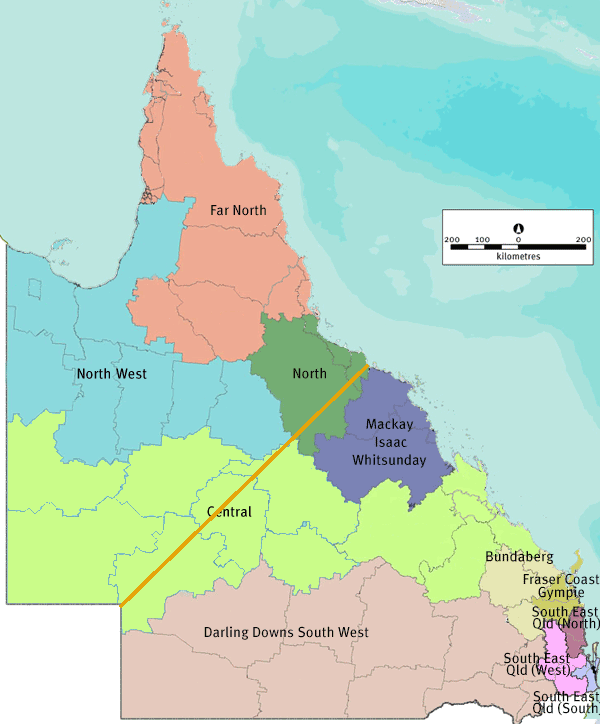
*Note that the population figures calculated for Queensland include three LGAs (Local Government Areas) in Central Queensland; Diamantina (Birdsville, etc., population 266), Winton (1,129), Boulia (458) and the region of North Queensland. The straight line border as shown (see the map below for detail) cuts through these areas. For the purpose of this calculation, the populations in parts of the North region that fall south of the straight line border are estimated to be approximately equivalent to the populations that fall to the north of it in the Shires of Barcoo, Longreach and Barcaldine.
Western Australia’s population of 2.8 million would fall only fractionally. Queensland’s population of 5.2 million would be reduced to about 4.62 million. These figures seem to be pretty good trade-offs for the creation of a new state, but much would hinge on which way Townsville and Broome decide to go. Of course these figures do not include projected population growth. Personally, I wouldn’t expect a sustainable population in Capricornia’s to go beyond 1 million.
CONSTITUTIONAL ISSUES
Prof Anne Twomey explains that the constitution draws a distinction between ‘original states’ and ‘new states’. Original states were guaranteed equal Senate representation and a minimum of 5 seats in the House of Representatives. This was designed to encourage Western Australia to join the Commonwealth, which it did, at the eleventh hour. New states would not necessarily get 12 Senators or 5 seats in the Lower House. It would depend on what was agreed in the Commonwealth parliament. Section 124 of the Constitution outlines the laws for splitting, merging or creating a new state. Consent of the parliaments of the states effected must be procured, including the Commonwealth Parliament. That means all four parliaments affected by the creation of the state of Capricornia must approve enabling legislation. Indeed, it is likely that the approval of electors would also be required across not just the two states and the territory involved, but the country as a whole, because the creation of Capricornia would affect the proportionate representation of every state and territory in the Commonwealth parliament, not to mention their financial arrangements with the Commonwealth. There would be concerns about the burden on other states if they could not be persuaded that Capricornia would be able to support itself.

Another decision that would be required is what representation the new state would have in the Commonwealth parliament. Presumably the states of Western Australia and Queensland would retain their status as original states and therefore their 12 senators each. How many senators would be allocated to the new state?
Also, Section 124 says the number of members in the House of Representatives shall be approximately twice those in the Senate. Therefore, if Capricornia were to receive 12 senators, it would have 24 Members in the House of Representatives. The Northern Territory currently has 2 senators and 2 members in the lower house. Therefore the creation of Capricornia would see no more than an increase of 10 Senators to the Senate and 22 seats in the lower house. With a population of only about 800,000 (not all of whom are constituents eligible to vote), this seems excessive given that the ACT has only 2 senators representing about 475,000 people. Once the issue of representation is raised, the ACT would point out this unfairness and call for an increase in its representation, probably arguing that it should be at Capricornia’s expense. The ACT has 3 seats in the lower house, a number which as risen and fallen (by one) over the years – proving change happens. It might be reasonable to suppose that Capricornia would get at least twice as many senators and MPs as the ACT – something like 8 in the upper house, 16 in the lower house.
These political challenges are herculean, to say the least. Australian’s tend not to like the idea of increasing the number of politicians. However, the country’s population has risen dramatically over the past two decades, giving politicians more constituents to represent. If the merits of the creation of a new state genuinely exist and the people are persuaded, there is no reason to believe it is not achievable. However, there is no doubt that the process could take at least a decade or more.
Let’s have a look at the political conditions in each state and territory that would make up Capricornia.
The Northern Territory
Territorians voted in a referendum on statehood on the 3rd of October 1998. Prime Minister John Howard offered them the opportunity after overruling their legalization of euthanasia two years earlier. The vote narrowly failed, split between those in favour in the cities and towns versus the Aboriginal Land Councils who distrusted the powers of a state government over them. Reassuring Aboriginal communities that their interests are included in a new state, whether they come from the Territory or the other states, will be very important.
Statehood ambitions were highest in the 1980s and 90s after the NT achieved self-government in 1978 (ABC). After the referendum loss, enthusiasm waned and because the population boom that was expected never materialized, it pretty much evaporated. The NT is funded like a state since striking an agreement with the Hawke government, so the impetus for statehood is just not there. Any new state in the region requires an adequate population to justify its elevation to statehood. By absorbing neighbouring population centers as described above and by encouraging development for, among other things, climate change adaptation, the NT could meet the requirements for statehood as Capricornia.
Queensland
Queensland is the most populous of the three state/territories, potentially bringing more than 300,000 people into Capricornia. A border that captures most population centres within an equidistant range of Darwin and Brisbane (or better) would include the regions of Far North, North, North West and the western third of the Central Queensland. Of course the border line doesn’t have to be perfectly straight; it could meander along existing LGA divisions, more or less.
This is the only regional area of Australia that has separatist political representation in both the state and federal parliaments. Katter’s Australian Party policies fiercely defend local interests and reflect popular opinion in north Queensland that the south east of the state is too remote and neglects the north. Bob Katter is the federal member for the very large electorate of Kennedy (as of the 2022 election – Kennedy has 171,402 people) and has led the charge for a north Queensland state. His son Robbie represents the state seat of Traeger. The neighbouring coastal seats of Hill and Hinchinbrook are also held by the Katter’s Australian Party which, combined with Traeger, cover similar territory to the seat of Kennedy (as of the 2024 election).
According to The Courier-Mail in 2010, the majority of North Queensland Mayors were in favour of the separation from Queensland proper. Only two of the hundred delegates at the NQ Local Government Association meeting were against the proposal – the two being Mayor Val Schier (Cairns) and Mayor Ben Callcott (Charters Towers).
Menzies House
North Queensland is a mixed bag when it comes to secession. The Katter’s Australia Party has run candidates in the neighbouring electorates to the north and south of the state seats and the federal seat in which they have elected representatives in parliament. Cape York at the federal level (Leichhardt) is held by the LNP and the Katter party’s Rod Jensen trailed in 5th place on first preference votes in the 2022 election (see Leichhardt electorate of Cape York/Torres Strait – 175,620 people). Charters Towers is in the south east of Bob Katter’s seat of Kennedy. The City of Townsville is in a separate electorate (Herbert) and held by the LNP (Liberal National Party). South of Kennedy are the electorates of Dawson, Capricornia and Maranoa, also usually held by the LNP. In Herbert, the Katter party’s Clynton Hawkes garnered 7% of first preference votes in 2022. A straight line border from the north east corner of South Australia to Townsville would include the shires of Diamantina (Birdsville), Boulia and Winton in the federal seat of Maranoa, also strong LNP voters.
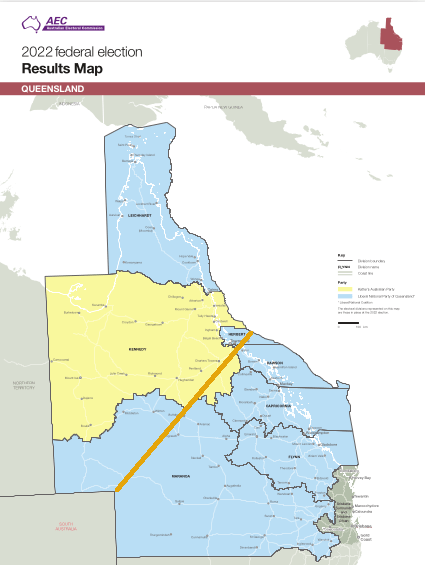
In the Senate, the Katter’s Australia Party fails to garner much support from Queenslanders, suggesting their supporters are a small proportion of the population and enthusiasm for their cause is not widespread. The only KAP Senator was Fraser Anning who was elected as an independent in 2017 and joined Katter’s Australian Party in 2018, but was expelled a year later for insisting on an immigration policy that distinguishes between Europeans and non-Europeans.
Townsville is pivotal to the creation of Capricornia given the number of people it would bring into it. It is larger than Darwin by about 40,000 people and larger than Cairns by about 25,000. It is also a very important sea port and military base. The people of Townsville may feel it should be the capital, not Darwin. However, it would be inappropriate to transfer all administration from Darwin where it is already established. As the most decentralized state, Capricornia could spread government offices across Darwin , Mt Is, Townsville and Cairns.
In the state seat of Townsville the Katter party’s Margie Ryder won a respectable 12.6% of first preference votes in the 2024 election. It is held by the LNP with 41.25% of first preference votes. Just south of Townsville, in the Burdekin electorate, the Katters’ Daniel Carroll won 8.5% of first preference votes. The Katter party didn’t field a candidate in the seat of Gregory, south of Treager, which is also held by the LNP with strong two-party preferred support at both Boulia and Winton polling booths.
Sentiments for a separate state in north Queensland are long-standing. The North Queensland State Alliance has the stated objective of promoting and delivering Self-Government and Statehood for North Queensland. It achieved representation in Townsville City Council’s Division 10 when Fran O’Callaghan was elected in a by-election, serving from 2021 to 2024. In 2019 Whitsunday MP Jason Costigan set up a new political party ‘North Queensland First‘ (News.com.au) with similar goals. Recently, Robbie Katter moved a motion in the state parliament proposing a north Queensland state which was rejected. Katter claimed that the region was being neglected by the state’s South East, particularly in the areas of investment, infrastructure and disaster relief.
These proposals seem to have been raised without adequate research.

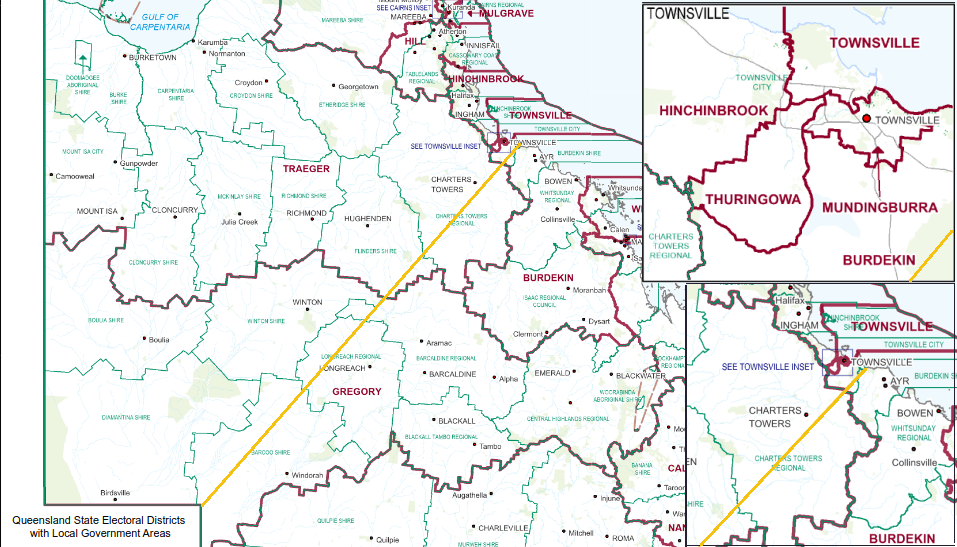
North Queensland electoral boundaries: AEC (federal) map on left and ECQ (state) map on right
There is a provision in the constitution that allows for some of the 12 Queensland Senators to be allocated to represent certain regions of the state “until parliament otherwise provides”. (‘Queensland and Kingsland‘). The Commonwealth parliament could therefore has the power to enact this allocation. It would probably be worthwhile allocating 2 senators to represent north Queenslanders in order to better understand their unique needs. A period in which these senators serve could provide more information to evaluate the merit of secession to Capricornia. Queensland is a single electorate with proportional representation and north Queensland only gets representatives by chance if a local candidate is available, is popular and has a high enough position on the ticket of a major party. Currently (since the 2022 election) it has 2 senators; one from Cairns (Nita Green, ALP) and another from Townsville (Susan McDonald, LNP).
Western Australia
The Kimberley region in north east Western Australia north is separated from the rest of the state by a vast expanse of arid, unpopulated desert. Most of that area is the eastern part of the Pilbara Region.
There is no evidence that the people of the Kimberley want to separate from WA or merge with the NT. Secession is out of the question for such a tiny population and merging with the Northern Territory may be thought of as a step down, putting it into greater financial precarity. A Kimberley/NT state would have about 294,451 people, fewer than the ACT, so it would not have the tax base for statehood. Based on my research, it appears nobody there has considered merging with an enlarged northern state like Capricornia.
At the state level, the region is represented by the seat of Kimberley in the Legislative Assembly. Kimberley votes ALP or Liberal at state elections and the ALP holds it as of February 2025.
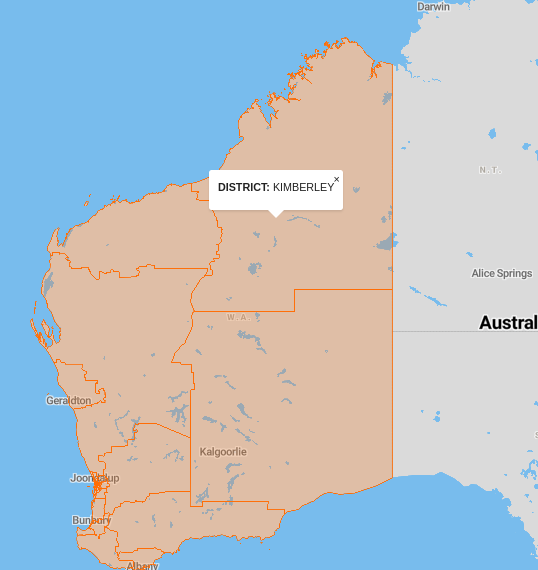
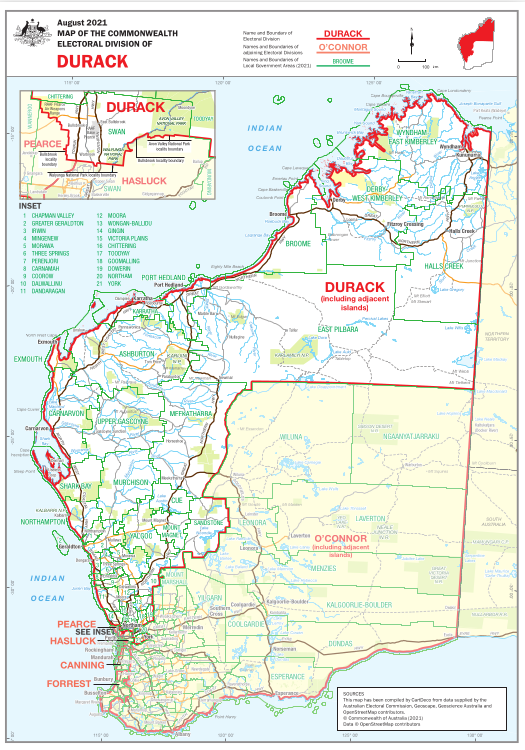
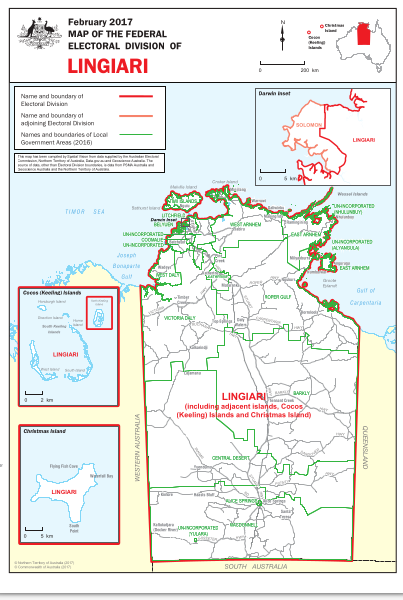
The Western Australian Legislative Council is similar to the federal senate as of the 2025 state election – one whole electorate employing a preferential voting, proportional representation system. The ALP reformed the LC’s electoral systems to remove the division of it into 6 electorate with 6 members each. Kimberley was included in the largest electorate, the Mining & Pastoral Region. As of the 2025 state election the Kimberley will only have one MP based in their area – Ms D’Anna, in the lower house. For more on this, see my review of the WA Election Results.
Neither the NT or Queensland have upper houses, so the Kimberley region would be moving into a unicameral system of state government if Capricornia was not set up as bicameral.
At the federal level, Kimberley is part of the electorate of Durack, which extends all the way down the west coast to Perth.
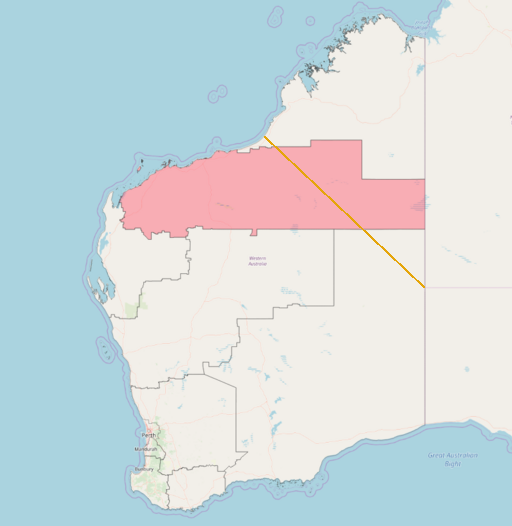
Imagine a straight state border running direct from the south west corner of the NT and South Australia directly north west across the Gibson and Karlamilyi deserts, touching the coast at just north of Eighty Mile Beach on the north coast of WA at 19.43º S. This would put approximately 765,625 square kilometers of WA into Capricornia.
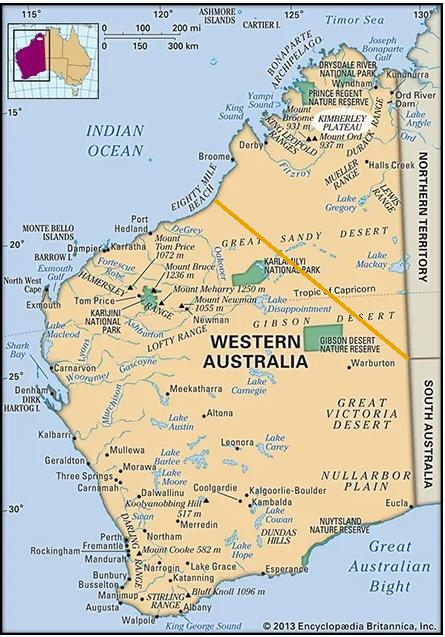

There are 7 shires in the area encompassed by the Capricornian border as envisaged here. The border runs through the rich mining Pilbara Region, giving the eastern half to Capricornia. However, the Pilbara ports are at Port Hedland, south of the imaginary border. Extraction of minerals from mines in Capricornia could be transported on the Iron Boomerang which would traverse the border though the Pilbara Shire. Royalty rights to Capricornia would need to be worked out between the relevant mining companies, the WA, Capricornian and Commonwealth governments.
At the federal level, the Kimberly part of the seat of Durack would be redistributed into the seat of Lingiari. Other redistribution considerations would be up to the Capricornian Electoral Commission.
At the state and local government level, the existing electorate of Kimberly and its seven shires would become part of the state of Capricornia.
Western Australians are crowded into the south west corner of the state. Perth is much closer to Adelaide by air, road and rail than it is to Kununurra. Broome is closer to Darwin than it is to Perth.
Maps often use Mercator projections that stretch out the south of the continent, giving the illusion that Perth and Adelaide are further apart than they actually are. Robinson projections show longitudes as curved lines, giving a more accurate depiction of distances near the poles. The map on the right uses Mercator projections. The Geoscience map above uses Robinson projections.
Christmas and Cocos (Keeling) Islands
The Australian External Territories in the Indian Ocean comprise about 3,292 people. These territories are administered by the Australian federal Government but “many public services – including health, education, and policing – are provided by the state of Western Australia, and Western Australian law applies except where the federal government has determined otherwise. The territory also uses Western Australian postcodes.” (Wikipedia) Both territories are part of the federal electorate of Lingiari. A decision would have to be made as to which state provides public services – WA or Capricornia. It would seem logical for WA to continue for some time after the creation of Capricornia because it has a larger tax base and systems are in place. This would allow time to assess service delivery with a view to a possible transfer or division of responsibilities.
STATE ADMINISTRATION AND CONSTITUTION
Capricornia’s constitution should be formulated with all the lessons of state and federal government history in mind. It should be conceived in the context of a modern Australia, not a colonial one.
The Constitution should, as the Commonwealth Constitution does, guide the state’s legal functions, not prescribe them and allow the parliament to determine specifics, informed by the judiciary and the constituents.
The Preamble to the Constitution of Capricornia should elucidate the context of the state’s conception and give voice to its purpose; the well-being of all within its jurisdiction, including its ecology. It should include a statement acknowledging the history leading up to its conception that is balanced and accurate and one that all reasonable citizens can accept and support.
There are numerous systems of government to consider, including unicameral or bicameral chambers and different electoral systems. The trend across the country suggests a bicameral system of fixed, four year terms for both houses based on preferential voting and proportional representation in multi-member divisions is preferred. The Tasmanian Hare-Clarke system is an Australian innovation thanks to Thomas Hare, the original inventor of single transferable voting, and Tasmanian Attorney-General Andrew Inglis Clark, one of the authors of the Commonwealth constitution. A version of it is also practiced in the ACT. Bicameral governments appear to have avoided entrenched gerrymandering which produced the conservative National Party government of Joh Bjelke-Petersen in the Queensland parliament for 20 years around 1980. Without a house of review, that electoral malapportionment took a long time to rectify.
Time Zones
Capricornia would adopt a time zone appropriate to its coordinates. South Australia is half an hour behind the eastern states because Adelaide is so close to its eastern border. Capricornia’s cities are dispersed across the state. The NT sits in the middle and has a time zone of GMT +9 (without daylight saving). This would suit Capricornia. Time zoning would improve for cities close to the current NT border such as Kununurra and Mt Isa. Townsville and Broome might be less enamored of it. Daylight saving would not be appropriate for Capricornia because most of its population centres are north of the Tropic of Capricorn. Queenslanders outside Brisbane, especially in the north west, overwhelming voted against daylight saving in a referendum held on the 22nd of February 1992.
Summary
Capricornia ties a bow on the Commonwealth and puts the final touches to our Federation by creating a new state in the north that combines the Kimberley region of Western Australia, the Northern Territory and the northern third of Queensland. The new state of Capricornia is a strategic development project to improve utilization of the tropical north and enable the population to adapt to climate change by allowing migration from the drying, heating south to live in tropical conditions in comfort in Earthships with solar powered air conditioning. The project will unite Australians and Aborigines in a common sense of purpose and invigorate the nation in a can-do attitude. Capricornia will have the resources and population to sustain itself economically and provide better regional security in coordinating Australian Defence Forces to protect the nation’s vulnerable northern flank.
Simon Cole 5th March, 2025
Acknowledgment to Contributors: Max Hooper
Capricornia © 2025 by Simon Cole is licensed under CC BY-NC-ND 4.0
Have Your Say
Now that you understand the concept of Capricornia, what do you think?
If you would like to collaborate in the dissemination of this information, please send a message via the Contact Form.

Leave a comment