
Permaculture and regenerative agriculture aren’t “solutions” to our predicament.
I have told many people my lifestyle is well suited to preventing societal and environmental collapse, but it’s not suited to living in a POST-collapse future. That’s because it lightens the load a lot, but is still very connected to the system.

Andy Kenworthy explains it eloquently in his article Why Gardening Won’t Save the World in which his 20 years of permaculture and eco-village living informs his practical reassessment of permaculture enthusiasts’ claims.
“I don’t believe permaculture and regenerative agriculture are “solutions” to our predicament. “Andy Kenworthy
“It represents the lifestyle we’re all working so hard to avoid”, he says. “A lot of what some environmentalists consider denial or ignorance is really people knowing their options only too well. They have decided that they rather like their affluent industrialized lifestyles. They’re not going ‘back to the land’ until they are forced to by poverty or at the point of a gun, as has already been test-run by autocrats throughout history. “
“My key point is that once we stop grasping for illusory ‘solutions’ we will get better at getting on with reality, with all its complexities and mess.”
The ‘rurban’ hybrid semi-off grid lifestyle is how I get on with reality with all its complexities. It is not a back-breaking, back-to-earth life on the land. Rather it is a grounded, semi-self-sufficient suburban block in a metropolis. It’s a modern version of living lightly on the planet.
For example, I explain to my guests and tenants that the house is fully insulated (walls included) and the best way to control the temperature is to use windows, doors and blinds. Passive home design and sustainability advisors explain that behaviour is a big part of efficient energy use: In summer, open everything up at night (and make use of cross ventilation) and close up in the morning before the heat rises. Do the reverse in winter. In autumn and spring here in Brisbane, there is no need for it. It makes little difference to humidity, but around the summer and winter solstices, it’s truly worth it.
Despite repeated explanations and gentle nudges, my transient guests resist taking up habits that would make their immediate experience and space more comfortable. That is not to mention the benefits to the environment. Mainstream people who stay here for months on end typically retain their wasteful habits. As Andy says, people won’t adopt hardcore permaculture because we’re quite attached to the benefits of our industrialized world. However, my experience suggests they find it very challenging to adopt energy efficient behaviour.

It’s too easy to call it ‘laziness’, ‘indifference’ or ‘selfishness’. I’m left wondering why I’m different. Part of the answer is that I am semi-off-grid from employment and the monetary system, too, so I have the time to use my body a little more at home. Most people who go out and work everyday, want home to be a very relaxing place. I do, too and it is, but home is not just a sanctuary for me, it’s an enterprise in more ways than one.
We are trained from a very early age to fit into a schedule. From kindergarten to employment, our time is organized for us. For most people, resources are only accessible through a highly commercialized system. We work hard for the money and then spend to make life easy. Who wants to open a window or a blind after a hard days work when you can throw a switch or two? Also, if the power is included in the rent, it’s the owner’s problem.
But if you’re independent of the employment grind, getting up off your butt keeps you fit. It doesn’t wear you out. The thing about energy efficient behavour is it becomes easy and effective when it’s habitual – a sort of ritual that occurs, dependent on the weather.
When your time is your own, you have the time to observe more deeply. Only then might someone who stays with me long enough notice things without being told. For example, the ground floor has a better year-round temperature than upstairs because its on a concrete slab and upstairs insulates the ground floor. The wet areas have been placed on the western side to insulate the house from afternoon heat.
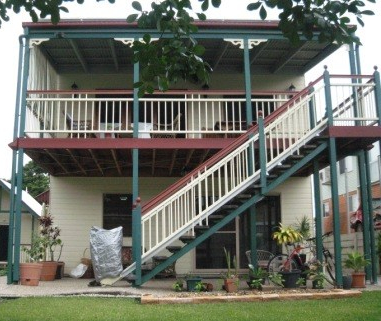
Inequality in a highly technological and monetized system sustains a disconnect between people and Earth. “This place should have aircon – it’d save me some trouble.” My tenants don’t think of energy and materials as planetary resources; they are the owners’ belongings. What’s the weather going to be today? “I’m going to work. I don’t have time to check the weather. I’ll be in the office in air-conditioning. Someone else can do it – who ever is staying home. My room won’t make much difference.” Whatever the excuses, it’s odd to put up with uncomfortable temperatures when the solution is in front of you.
One way I’ve noticed I’m different is the extent to which I’ve striven for independence and self-reliance. It always seemed important to get to a point where I could give back. Achieving the right distance from the monetary system has been crucial to ensuring it has very little say in what I do and when I do it. Work is a necessary part of everyone’s life – or should be. But not pointless work, such as spruiking property prices. Work that is fundamental, like maintenance, cleaning and production of essential household items, such as food. Simplicity lightens the load on the planet and reduces maintenance, but involves a little extra work. When you’re caught up in the daily grind of the rat race, that little bit of extra work is too much to bear.
For a diary of my investigations into doing sustainable and intentional living in the city, go to Rurban Eco Hub Brisbane.
