
Can Mutual Credit and Gifting Triumph Over Debt?
People often say of complimentary community currencies, “I don’t know why it hasn’t taken off – it’s such a good idea!”

In this opinion piece, I look at the behavioral barriers to mutual credit’s success, and suggest some solutions.
I managed and promoted the Brisbane Local Exchange Trading System (BrisLETS) for 2 years. During that time, the fundamental issue confronting me was “We can buy almost anything with the Aussie dollar, so why bother with LETS?”
The question raises two issues about LETS; its utility as a means of exchange and its function as a socially-beneficial alternative to the debt-based dollar.
As a socially beneficial alternative, it ticks several boxes: It is fair money that is not a pump for the wealthy. From a social and sustainability perspective, it associates us with like-minded people, who support a spirit of generosity, waste reduction and localization.
In terms of its utility, there are financial and practical issues: You don’t need dollars to trade; you don’t need to buy ‘Units’ and there is no currency conversion. They are like inches and centimeters; an unlimited means of measurement.
However, the purchasing power and ease of use of a currency is crucial to its success.
What is ‘success’?
Bitcoin has attracted a great deal of attention and appeal because it has become a valuable investment commodity. One Bitcoin is worth thousands of dollars. People want it (even though its retail acceptance is limited) because it can be speculated on and converted to dollars. It is very easy to use because it is a crypto-currency and criminals like it because it by-passes banks and a lot of government regulations. Primarily, it is a tool for wealth accumulation. It certainly fails to change the culture of greed.
LETS on CES (Community Exchange System) is not convertible to dollars, rather, it is mutual credit. This sets it apart and is its draw-card. What makes it intrinsically more valuable than the debt-based currency of the mega-rich is that it cultivates the wealth and well- being of the community.
However, it is hampered by the lack of goods and services on offer and its difficulty of use. In other words, its small scale and limited retail recognition is discouraging.
Technology
For years, LETS exchange groups have struggled to overcome these barriers. CES in Australia has super-powered what LETS was doing on paper, but it is far from perfect. It requires time and training. One technologically promising light on the hill is mutual credit as crypto-currency on the Holochain. However, this is still in its infancy. They would almost certainly go much further in solving the ease-of-use problems that CES has made a start on. Some of you may be interested in philanthropically supporting these endeavours by members of the open-source community.
Values
Mutual credit also requires time and training for users to grasp the basic values that are so different to the dollar system. However, people are drawn to it because they are open to its values. It just requires an adjustment period. It also takes some time for people to develop trust and confidence in the system, in order to bring something of real worth to it. When they are ready, they can add value to the mutual credit economy by;
- valuing the opportunity; in other words take the time to learn how to trade on the system. Think of it as “building the alternative”.
- trading entirely in mutual credit when you would otherwise have traded in dollars (big ticket items such as flat-screen TVs, cars, property and houses, specialist services, etc., bring a great deal of value to the currency),
- donating goods, services, skills or dollars to the organisation and community.
A critical element in the adjustment for most people is to offer services and goods of real value. Not just excess food, second hand goods and basic services, but boutique products and expert services. This requires a spirit of philanthropic generosity by the dollar-rich. Without this, LETS will remain a recycling market on the fringes of people’s economy. By investing in LETS, the payout is a healthier, happier, safer and more vibrant community to live in. Sadly, as long as a mutual credit system is populated and supported by mainly dollar poor people, it is unlikely to take off.

Good Growth
Many local currency systems like LETS are appealing for social reasons. It associates us with like- minded people, who support a spirit of generosity. Whilst this may have the feel-good factor of a congregation, it can hold the system down in size and value. The key to mutual credit going beyond a small social circle is to introduce an element of competitiveness with the dollar.
While LETS/CES remains a small social circle, it will continue to eat itself up. This is only natural. When people come together to help each other, it’s healthy to allow transactionalism to dissolve into trust. We become friends and no longer need to ‘keep a track of favours’. We no longer need to use CES. The love grows. Therefore, its greatest virtue is its undoing, in a sense.
Shift Happens
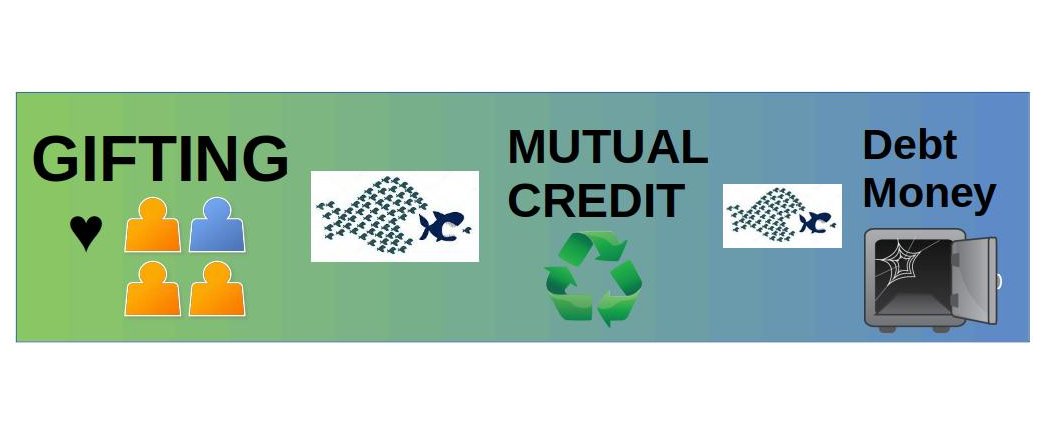
However, the way out of this conundrum is to compete with the dollar market; draw in newcomers and expand the mutual credit economy. This in turn will expand the gifting within the association of mutual credit users. Success is an ever-expanding society of giving, sharing and trust that gobbles up value from the dollar economy.
Administration and management
Running a mutual credit system is a complex business and this brings us to the third and final impediment to LETS’ success.
As long as exchanges are run by well intentioned novices offering their time as volunteers with a hobby-like interest, making decisions on a consensus basis, the complexity of the issues involved will always prevent them from being able to offer a system that has real appeal and reasonably easy uptake. The concepts I’ve described above are not the only challenges. Monetary systems and their online platforms become very complex very quickly as soon as one turns attention to the details of where the money comes from and how it should circulate. One way or another, Traders have to bite the bullet and put their faith in a dedicated team of highly skilled member traders to run the exchange. Transparency is essential and this team should always be ready to educate and share their knowledge and skills. This is essential, because it provides a path for ordinary users to become part of the team and raises the general skill level of users. Like the inner workings of a computer, the mechanics are only obscured by its complexity. The results of the teams’ efforts – a more successful mutual credit economy – will be enjoyed by all who use it to trade, just like those who enjoy using computers and cars without any idea of how it works under the bonnet. This should be the test of the trust placed in those who have skilled up enough to run the exchange efficiently.
This team should be properly paid in mutual credits to support their time and livelihood on a regular, part time basis. Given the workload, the admin team should leave member traders to organize community and social events themselves, while they concentrate on office work.
LETS was originally conceived late last century in Canada by Michael Lindon to protect and retain economic value in a town that was being adversely affected by an external company. Regional cities can be disrupted when big business moves in and out at will. However, operating a mutual credit system of multiple local exchanges in an attempt to protect local economies, each requiring their own administrators, etc., adds layers of complexity and duplication. This is unnecessary while the system is too small to influence major employers.
14 May July 2022 By Simon Cole


Leave a comment