
Brisbane Needs a Hero
Sadly, there couldn’t be a greater contrast between the run-up to the Sydney 2000 Olympics and the clusterfuck that’s unfolding in Brisbane prior to the 2032 Summer Games.

Sydney had grassroots community involvement even before the bid succeeded – with Greenpeace on board. That hardly seems possible these days. The result was a watershed example for a sustainable Games. It left its mark on the IOC (International Olympic Committee), which is now committed to sustainability and climate ready guidelines. However, these guidelines are also an outcome of a history of budget blow-outs and white elephants amid residents’ and even politicians’ growing reticence to host the Games. Discontent with the prospect of increased taxes and widespread disruption has become commonplace. It takes an unusually cohesive city to pull off what Sydney did. But here in Queensland, politicians have become remarkably disconnected from the sentiments of ordinary residents. In their enthusiasm for the Games both the City and State governments are now at loggerheads with the people of Brisbane, especially over the issue of a new stadium. What they have in mind will reduce Brisbane’s already low green space per capita. Contrary to Brisbane’s reputation, it has one of the lowest ratios of inner-city green space among Australian capitals compared to cities like Sydney and Melbourne.
It’s A Money Spinner For Developers
The background scene in Brisbane is one of coercion. Across the country, unprecedented levels of immigration instigated at the Federal level is increasing tensions between government and people and what has become the ‘tribes’ of Australia. Here in South East Queensland, we have the highest population growth in the country. High levels of immigration since the mid 2000s have flown in the face of public opinion, despite Labor’s romping success at the polls earlier this year. In Brisbane, as Matt Barrie eloquently explains in his recent X post, ‘The Great Immigration Scam‘;
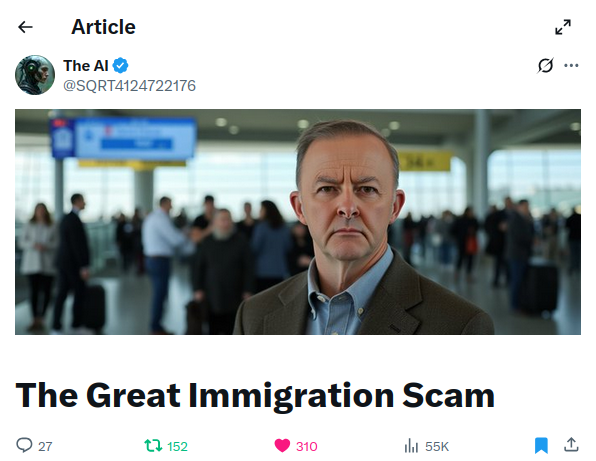
“the sole purpose of immigration is to increase corporate profits“
It is immaterial that both state and local governments are current held by the LNP (Liberal National Party), because the former Labor state government was also riding rough-shod over local governments’ planning processes to speed up construction of new housing by increasing density as well as sweeping aside environment protections. It hasn’t helped that the LNP has had a strangle-hold on the Brisbane City Council for an incredible 20 years, thanks in no small part, I believe, to their marketing gerrymander. that they’re trying to replicate at the state level now by changing the colours from maroon to blue. Both sides of politics are married to ‘development’ and ‘growth’ like it’s an addiction. It’s driving Queensland into a $200+B debt bubble. Not too long ago it was only $70B. Federal Labor’s ‘nation-building’ aspirations are just code for more accommodation for foreigners that represent an upgrade for them and a downgrade for Aussies. Apparently that’s social justice and more equality.
The Olympics – Development on Steroids
What could raise the stakes higher on a region struggling to meet the demands of extreme population growth? The Olympics! Now don’t get me wrong, aspiring to host the world’s premier sporting event is very noble. Sport is iconic of human health and vigor. It is a proud moment in any city’s history to host the Olympics – if it can do it well and leave a positive legacy. I have no doubt Brisbane can do it, but not the way we’re going about it, as Prof Marcus Foth has made clear.
Politicians in the cabinets of both the state government and city council appear to be intent on concentrating the Games in the city, despite the acquired wisdom to the contrary that the IOC Coordinating Commission is duty-bound to uphold. Spreading events out to other cities and regions is encouraged. Making use of existing facilities is regarded quite rightly, as more sustainable. Plans for the Brisbane Games include some events outside the city centre, such as rowing in Rockhampton and white-water rafting in Redlands. However, there is a preoccupation with building a massive stadium within cooee of the CBD. This is peculiar when we already have two stadiums near the centre – Suncorp and the Brisbane Cricket Ground (the Gabba).
I’m not across all the facilities proposed, but allow me to comment on the most note-worthy in the media.
Victoria Park Stadium
Premier David Crisafulli has made a very bad call choosing Victoria Park in Kelvin Grove. Not only does it break an election promise, but it creates a swathe of other problems. It reduces Brisbane’s already minuscule parkland space compared to other Australian capital cities. Victoria Park is Brisbane’s largest remaining inner-city green space and yet much smaller than parks in other major international cities.

The government has introduced a ‘POLA’ (Planning and Other Legislation Amendment) Bill to sweep away environment, heritage and planning laws to allow construction on a hilly, difficult plot right next to a major hospital. Perhaps the roar of the crowds will spur patients on to a speedy recovery?
“Our dinosaur state govt demonstrated with the Pola bill, which was passed last night, that they have no intention of engaging with the community. They will just do what they want unless we can cause major embarrassment somewhere for their poor planning and conflicted priorities.” (Save Victoria Park Kelvin Grove resident, email, 26th June)
Brisbane will lose the majority of its largest inner-city parkland to a pay-to-enter, hard surface precinct, according to sustainable development researcher Dr Neil Peach.
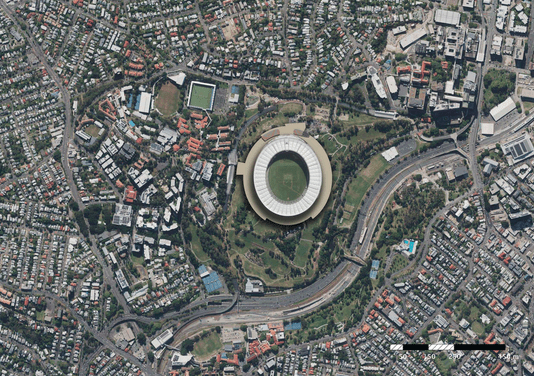

Professor Marcus Foth of Brisbane Flight Path Community Alliance has written a warning; Brisbane’s promise of a shimmery new Olympic stadium is part of a long bedazzling legacy of promises gone wrong (3 June 2025).

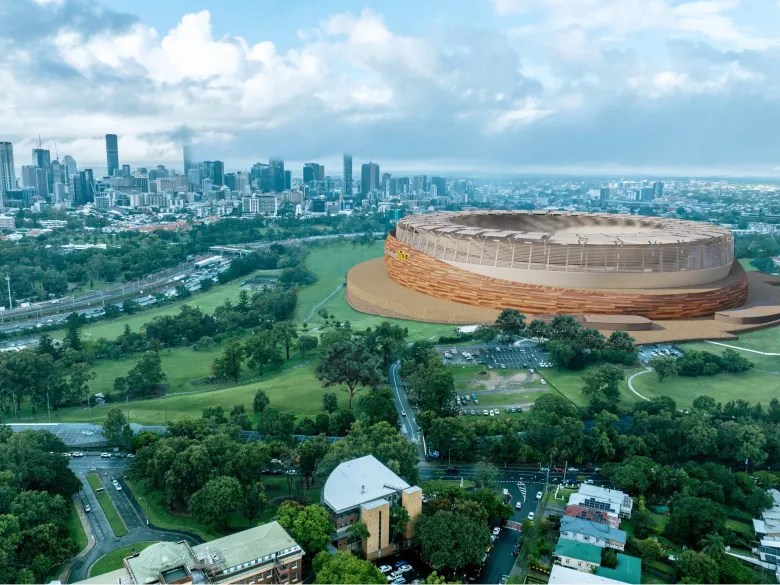
Alternative Stadium Sites
There are two options that pose far fewer complications even to the untrained eye. The Doomben/Hamilton gray-field riverside site is bigger in area than Victoria Park, reasonably close to the city (if that matters), serviced by busses and ferries and closer to the airport. Nearby Doomben train station is a similar distance as Exhibition station is from Victoria Park. Although it is flood-prone, that problem could be made to work by sitting the stadium on a ground-level car park. The result would be quite iconic for the river city.
Alternatively the Boondall Entertainment Centre, just half an hour north of the CBD, has a lot going for it. Like Doomben, it is easily connected to the airport. There is plenty of space and it is well serviced by a dedicated train station and the M1 freeway. Importantly, there are environmental (including koala) protections across much of the forested area within and around the existing structures that would need to be managed sensitively, but that can also be a draw-card for tourists.
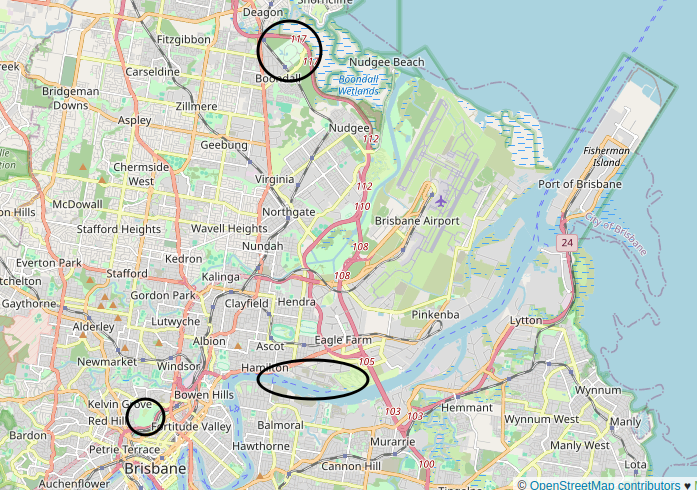
The QSAC or QEII Stadium in Nathan on the southside has potential, too. It would need a complete rebuild because the original stadium built in the 1980s was only ever meant to be temporary. It is not as well-served by public transport as Boondall. There is considerable student accommodation at Griffith University that would make a good athlete’s village. They are in a state of disrepair and require work, as found in the Palaszczuk’s state government housing crisis report that looked into low-cost social housing solutions. Apparently, that crisis has gone under the radar.
Other sports venues
There are also objections to the building of a white-water-rafting facility in Birkdale, Redlands:
A Senate inquiry into Australia’s preparedness to host the Games found a “high likelihood” the Redland Whitewater Centre could become a drain on the community when the Games are over.
ABC, April, 2025.
Advocates are asking why the existing whitewater rafting facility in Penrith, NSW, which was built for the Sydney Olympics and has run “at a loss almost every year since 2008”, isn’t the venue of choice. Sporting advocates claim a new facility will provide a boost to their sport, but they can’t guarantee there will be adequate demand, beyond sheer hope. Has anyone considered the Tully River in north Queensland – a famous whitewater rafting tourist attraction? Maybe we don’t need to build what nature has already provided? It could be an experiment in eco-friendly games hosting, putting spectators at a distance, watching close-up via drones.
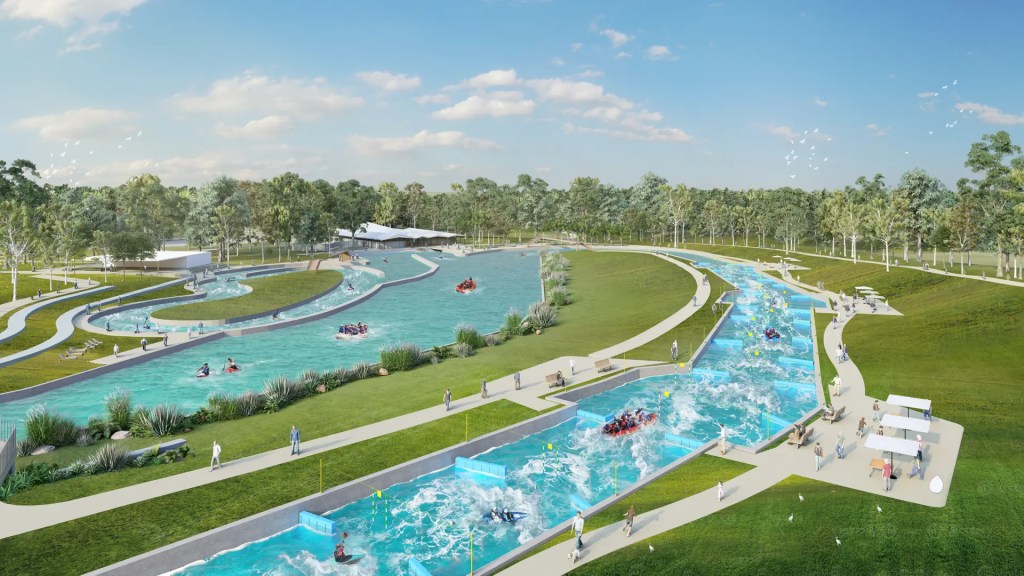
When one considers how the Games could be hosted with less development, it’s hard to see how all this isn’t driven by developer interests.
It Doesn’t Have To Be Like This
There are many brave and admirable champions of the, past and present, to draw inspiration from. Overseas, Denver Colorado set a precedent in 1972 when it changed its mind and handed the Winter Olympic Games back to the IOC. It took a local hero, Dick Lamm, to be a point person for the opposition. Denver had very little infrastructure to host the Games and a very environment-oriented community. How it won the games under those circumstances is not unreminiscent of Brisbane’s win – with a lack of consultation. Innsbruck, Austria volunteered to replace Denver with just 3 years to prepare. It had hosted the Games 8 years earlier and still had facilities intact. Unlike Brisbane, they held a plebiscite to test support, which succeeded. (Sports Destinations, 2017)
Should We Cancel it
No, but we should cancel the Victoria Park Stadium. We don’t have a point- man in Brisbane yet, but we have a point- team. In fact we have several of them. They’re part of a coalition of residents’ groups that has formed to address the untrammeled development the city has been experiencing for decades now.
Time is running out as the fight over the stadium threatens green space and heritage. Save Victoria Park is a valiant posse of residents who are taking the battle to court. The IOC heavyweights came under mounting pressure to uphold the Games’ new principles at a three-day meeting with advocacy groups. Save Victoria Park appeared on Channel 9 News and the Bar Association of Queensland spoke with the SDIWC‘s (State Development, Infrastructure and Works Committee) parliamentary hearing.
Brisbane Organising Committee (OCOG) president Andrew Liveris says, “the Queensland capital risks losing major cricket and AFL events to the regions without a “legacy” stadium to meet future demands”.
But former town planner Marian Wheeler pointed out that “If we had an 80,000 capacity stadium, we would have the third largest cricket stadium in the world and we would have the second largest AFL venue in Australia. This is a very, very large stadium, which is way beyond the justification provided by the level of usage we have from patrons at the Gabba.” 4BC Summer Drive
A stadium typically needs to hold at least 40,000 spectators to accommodate Olympic events, but many are much larger, with capacities often exceeding 60,000.
The Victoria Park stadium is planned for a capacity of 64,000.
Examples of Olympic Stadium Capacities
| Stadium Name | Capacity | Events Hosted |
|---|---|---|
| Los Angeles Memorial Coliseum | 77,000 | Summer Olympics (3 times) |
| Stade de France | 81,338 | Rugby, athletics at Paris 2024 |
| Beijing National Stadium | 91,000 | Summer Olympics 2008 |
| Sydney Olympic Stadium | 110,000 | Summer Olympics 2000 |
The Sydney Stadium’s capacity was achieved with some temporary seating that was dismantled after the Games.
Major events like the opening ceremony can attract full capacity, while other events may vary in attendance. Maximum capacity is generally only required for the Opening and Closing Ceremonies and further demand on a legacy stadium depends on uncertain future conditions, such as population growth. Given all the uncertainties that cast doubt on the future of such a major expense, erring on the side of caution and missing out on some patrons is justified. Montreal has only just paid off its 1976 Olympic Stadium white elephant – that’s nearly 50 years after the fact.
A Little Lesson Or Two From History
Antiquity managed to build amphitheaters and coliseums that stood for centuries. For some reason modern technology has gone backwards.

The Modern Olympics date from 1896 (London) and has been held every 4 years since, except for 1940 & 1944, which were cancelled due to WWII. By the early 1980s, hosting the Games had become such a financial liability, only Los Angeles and New York bid for the 1984 Games. Los Angeles won and it proved to be the most profitable one on record because the city reused existing facilities and it was funded by private business. The Coliseum there is now more than 100 years old – an example for all the world.
There is a growing case for limiting the Games to host cities that have previous experience and therefore have a proven ability to do so and can reuse existing facilities & transportation. Doing so makes the Games more sustainable, limits debt and environmental impact whilst eliminating the wasteful bidding process.
However, for the Games to live up to their international ideal, these ‘repeat host cities’ should be representative of their regions. The Olympic Rings represent the “5 continents of the world; Africa, America, Asia, Europe and Oceania”. However, Africa and the Middle East have never hosted them. Brazil has held the Games once.
For the Olympics to be both sustainable and truly international, new venues should be limited strictly to regions that have not hosted before.
Nations that have hosted or will host the Olympics

Since 1992, the Winter and Summer Games have been held 2 years apart. This allows some scope for sharing the Games out to both experienced hosts and new ones. Ideally, there should be 10 permanent hosts covering every region. The Games would cycle around those cities and each would host every 20 years. Facilities can be built to last beyond 100 years.
Egypt, South Africa, and Morocco have been acknowledged as future possibilities, although it is noted that increased dialogue and developments are needed.[31]
In addition, the Middle East, though not a continent (with most of the region situated in Asia), has never hosted an Olympic Games. Several nations have been in talks as potential hosts, but the only city to enter a formal bid was Doha (see also List of bids for the Summer Olympics).
Wikipedia
The northern hemisphere will always have an advantage for the Winter Games, but possible venues in the southern hemisphere include Argentina, Chile, and New Zealand.
How do you feel about Sydney being the permanent host of the Summer Games in Oceania? Comment below.
Brisbane’s Champion
Meanwhile, back in Brisbane, we need a champion of the people to capture a position of power. The Lord Mayor’s office in 2028.


Leave a reply to noisilymaker28c322b310 Cancel reply