
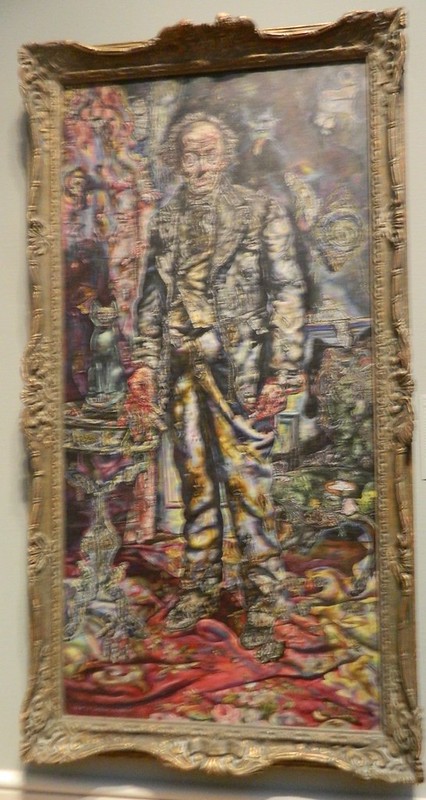
Like Dorian Gray
The ETHNICALLY BANKRUPT MAJORS are desperately Clinging To Fading Popularity
Last year, the Laberal duopoly colluded in an electoral “reform” bill and rushed it through both Houses of parliament. It further entrenches their already considerable advantage.

The Bill is very complex, even according to constitutional lawyer Professor Anne Twomey.
Every crossbencher voted against it. Little wonder – it is a wolf in sheep’s clothing:
Trade Minister Don Farrell, one of Labor’s canniest backroom operators, struck the agreement with the Liberals [Senator James McGrath], after months of preparation.
SMH
There was no multi-party committee of review.
Laws like this have effectively knocked independents out of the game in Victoria, says Zoe Daneil (ABC).
While there are some welcome changes, such as caps on political donations, the caps in effect limit the ability of independent candidates, new political parties, and political campaigners to raise funds, while leaving established parties much less constrained.
Like Dorian Gray, who sold his soul to the Devil in exchange for eternal youth, the major parties have dressed up an advantage to look like reform, trading democracy for eternal power. Dorian Gray’s aging was captured in his hidden portrait, until he uncovered it many years later and in a state of horror, stabbed it and died. One can only hope that one day the major parties will attract so many corrupt individuals that they implode.
The majors parties’ policies are more self-serving and disconnected from popular opinion than ever, particularly on the question of immigration, which they are sweeping under the carpet like they did at the last election. Their original ethos is waning, so they are relying on smoke and mirrors. The ALP, founded in the 19th century, has left workers behind just like technology has. (If they hadn’t, they might have thought of calling for a trial Universal Basic Income during COVID.) The Liberal Party abandoned its Menzian committment to the ‘little people in the middle’, between big unions and big business decades ago.
In exchange for the caps, well established parties and incumbent MPs will receive tens of millions of dollars more in public funding; in some cases, far more than the political donations that they are missing out on. Independent candidates, new parties, their candidates and political campaigners will receive nothing to compensate them for lost revenue. In other words, it trades private donations for taxpayer dollars.
The Centre for Public Integrity, a not-for-profit group led by former judges, says the public funding boost is unjustified. [SMH]
2025 – Last Chance Election
The changes will take effect at the next election, expected in 2028. This year’s election is pivotal. All signs point to a minority government with a larger crossbench. But it’s very unlikely to outnumber the two majors, even with the Greens’ included. The changes will be locked in.
From 2028 on, Australian politics will enter an era of even deeper dysfunction.
More Details of Dorian’s Deception
David Crowe, chief political correspondent of Sydney Morning Herald, explains how this Bill is definitely a case of one step forward, two steps back:

The glaring problem for the independents … is the cap on spending in each electorate. The law says candidates and parties can only spend $800,000 on a specific seat – much lower than the outlays of $2 million or more in some of the teal contests at the last election.
“Can the teals resist this $90m party invitation?” SMH
Independent candidates … will not have a national campaign behind them. A political party will be able to run national advertising that influences voters in each electorate without it being classed as “targeted” expenditure on the seat. That party could spend $800,000 on the local effort as well.
There is fury on the crossbench at the way the major parties have passed a law to help themselves. “It is so cynical and it will backfire, because it will galvanise and energise the independent movement,” says a crossbench adviser.
[Labor and the Liberals] have done a deal that keeps them hooked up to a Commonwealth drip. This is not sustainable over the long term: federal money cannot match committed volunteers.
David Crowe recommends the Teals form a party and fight fire with fire.
I wrote to every Queensland Senator on February 12th, the day they voted on it in the Upper House:
Dear Queensland Senators,
I write to express my concern that the above Bill serves to concentrate power more than ever before.
The majoritarian electoral system in the lower house favours the front-runner in a kind of gerrymander. It tends to herd people into one of two antagonistic parties and their ideologies. It stifles free thought. It fosters aggression and assertiveness over negotiation and compromise and bakes an adversarial culture into politics.
Voters are sick and tired of not being heard and not being represented by the two-party system. That’s why first preference votes to the major parties are at an all time low.
I urge you to take up the Australia Institute’s suggestions. [The caps on political donations per party should apply to each party as a whole – in other words, parties should not be able to divide the caps up to each of their state and territorial branches. Also remove the nominated entity exception to donation caps.]
We have a wonderful constitution in this country that guides our political process. However, too much power has been concentrated in parliament and it has become too impervious to public opinion. Future Electoral Reform should introduce citizen initiated plebiscites and proportional representation to the House of Representatives, along the lines of the Hare/Clarke system used in Tasmania and the ACT.
Yours sincerely,
Simon Cole
To date, only two Senators have responded – Greens Senator Penny Allman-Payne gave me a generic reply and Senator Larissa Waters included numerous errors about the Bill.
Voters have yet another good reason to preference the major parties last at the election on May 3rd. To continue the trend of their dwindling first preference votes, it’s very important to vote strategically and put the majors last.
Why Put The Majors Last?

The duopoly’s ugly, aging portrait is not hidden like Dorian Gray’s. They are unlikely to one day recoil in horror at what they’ve come, stab their inner demon and die. We have to do it TO them.
Reforms We Really Need
Getting their MPs on razor thin margins will help ensure they are accountable to constituents rather than their parties.
Dr William Coleman’s new research paper Twelve Ideas For Reinvigorating Australian Democracy states,
In The Rise of the Insiders, I analysed the occupational and educational backgrounds not only of the current federal parliamentary cohort, but also the backgrounds of parliamentarians at various points in our history back to 1901. In the first parliament, only 15 per cent of parliamentarians were insiders—meaning their employment immediately prior to entering parliament was in the public service, a political party or union, in consulting or lobbying, in the media (such as a journalist) or in publicly funded research or academia. In 2025, however, 60 per cent of federal parliamentarians were ‘insiders’, meaning the outsiders who are subject to the regulations and rules made in parliament—those in private sector businesses, tradesmen, farmers, doctors, and engineers—are being crowded out of parliament by the insiders.
IPA
‘Politics has become fully professionalised’ – something Victoria-based Democracy First (Get Career Politicians out of Canberra) is particularly irate about.
LONG TERM PLANNING
Really our long-term plan should be to get proportional representation introduced in the lower house to ensure that the only way a duopoly can emerge again is if it truly represents the views of the voting public. In such a system, MPs and parties have to negotiate coalitions to form government, forcing them to cooperate instead of being so adversarial. Even then, when a country is grappling with historic issues, a duopoly of sorts can still emerge such as is happening in Germany with the firewall against the AfD. Their PR system is complex and somewhat over-engineered, it seems, but it is more representative than it would be with our majoritarian electoral system. Basically their duopoly is caused mainly by the conservatives (CDU & AfD) being divided over immigration. Because the country is so big it is having a harder time marrying economic left and the social right policies like the Danish government has – smaller countries achieve social cohesion more easily. Another good reason to keep Australia’s population under 30 million!
END GAME
The major parties have become so dedicated to clinging to power that it overrides their convictions on anything. It is so all-consuming that they play to the middle ground on absolutely everything, even on an issue they could take a proper stand on that the majority of the electorate supports – like lower immigration – and score a significant victory!
We are in a state of state capture – by business oligarch and duplicitous individual politicians. We must break the mold and stab the picture perfect portrait.


Leave a comment